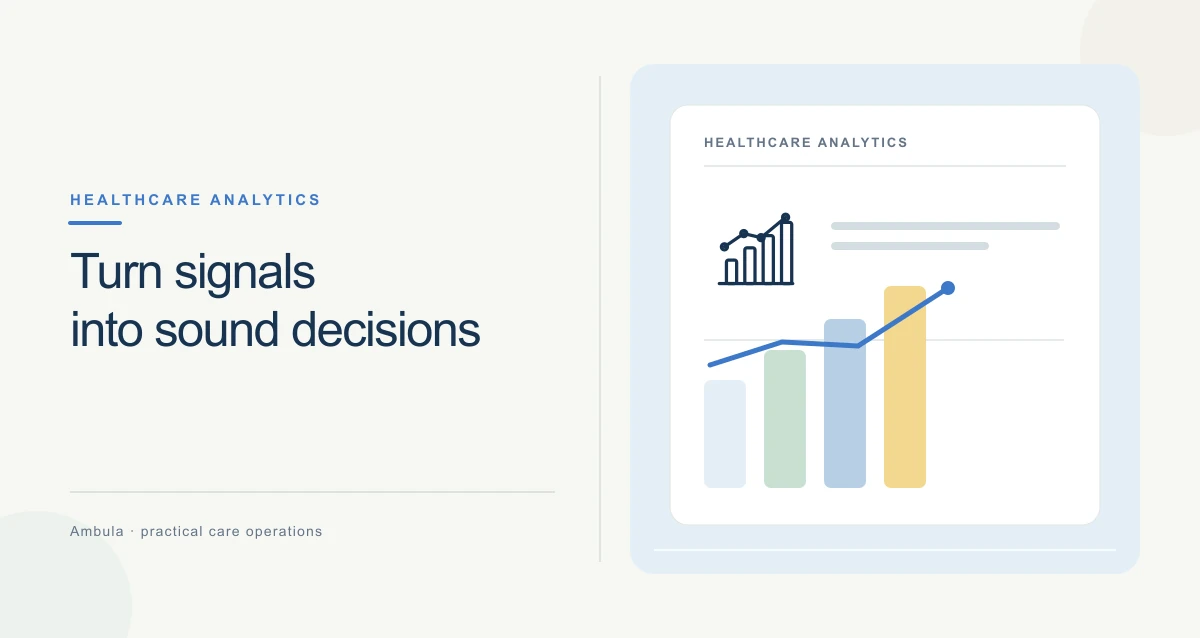
Healthcare business analytics uses operational, financial, and service data to help organizations understand how work is performing and where to investigate change. Analytics can support better questions and more informed decisions, but it does not automatically improve care or reduce cost. Useful analysis depends on trustworthy data, clear definitions, appropriate access, and people who understand the context behind the numbers.
What healthcare organizations use analytics to examine
- Access and flow: appointment availability, cancellations, referral completion, and time spent waiting.
- Operations: staffing patterns, resource use, workload, and process delays.
- Revenue-cycle activity: claim status, denial categories, days in accounts receivable, and payment reconciliation.
- Quality and experience: process measures, outcomes, patient feedback, and safety signals.
Each measure needs a precise definition, a data owner, an intended use, and a plan for interpreting variation. A metric may be useful for improvement without being appropriate for judging an individual clinician.
Build an analytics process people can trust
Start with a decision, not a dashboard
State the decision the team needs to make. “We need a chart” is not a decision question. “Where are new-patient referrals waiting, and what step can we test to reduce avoidable delay?” is more actionable.
Validate the data and definitions
Confirm the source systems, time period, exclusions, and how missing or duplicate records are handled. Compare samples with source records and document known limitations. When two systems define the same term differently, resolve the definition before comparing results.
Segment fairly and protect privacy
Break results down only when the sample and purpose justify it. Small groups can make individuals identifiable, and broad averages can hide disparities. Follow role-based access and applicable privacy safeguards, and share only the information needed for the approved analysis.
Interpret before acting
Ask frontline staff what the pattern might mean. A change in a metric could reflect a workflow change, seasonality, staffing, patient mix, data-entry practices, or an unrelated system issue. Treat an observed association as a prompt for investigation, not proof of cause.
Run a small improvement cycle
- Set a baseline and identify a plausible process change.
- Choose a small test and define what would count as improvement.
- Monitor both intended results and unintended workload or access effects.
- Discuss findings with the people doing the work.
- Adopt, revise, or stop the change based on the evidence.
Common pitfalls
- Using a visually attractive dashboard with unvalidated or inconsistent inputs.
- Tracking too many measures without a clear owner or action.
- Comparing teams without accounting for relevant context.
- Assuming that correlation establishes causation.
- Sharing sensitive or identifiable data more broadly than necessary.