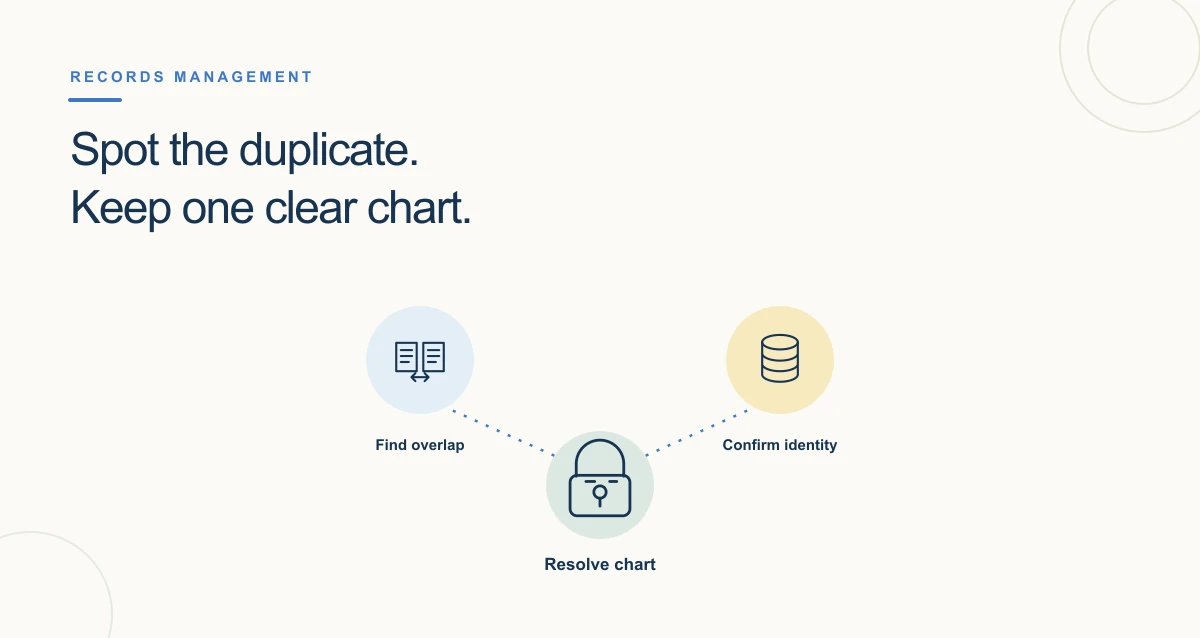
A duplicate medical record is an additional record created for a person who already has a record in the same health system. Duplicate records can fragment a person’s history across multiple charts. An overlay is different: information for two different people is combined in one record. Both are patient-matching problems, but an overlay can expose one person’s information in another person’s chart and create a serious risk if care is based on the wrong information.
Electronic medical records can support patient matching, but software alone cannot guarantee that every record is correct. Accurate matching depends on demographic data quality, registration workflows, staff training, system configuration, and a careful process for investigating and correcting potential matches.
Duplicate records vs. overlaid records
- Duplicate: one person has two or more records in the same organization, often because a new record was created when an existing one was not found.
- Overlay: information belonging to two different people has been combined in one record, often after an incorrect match or registration.
- Fragmented record across organizations: separate health systems may each hold records for the same person. That is not necessarily a duplicate inside one system; linking records across organizations involves interoperability and matching processes.
The Office of the National Coordinator for Health Information Technology (ONC) describes patient matching as identifying and linking one person’s data within and across health systems. It notes that matching uses multiple demographic fields, such as name, date of birth, phone number, and address. No single data point should be treated as a complete identity check in every situation.
Why duplicate or overlaid records happen
- An existing chart is hard to find: a search may miss a record because details differ, are incomplete, or were entered in another format.
- Demographic information changes: names, addresses, phone numbers, and other attributes can change or be recorded inconsistently.
- Similar identities create ambiguity: people may share names, birth dates, or other attributes, making a match based on too little information unsafe.
- Time pressure or interruptions: a busy registration process can make it harder to verify details or search carefully.
- Policies vary across sites: different naming conventions, temporary-record practices, or registration rules can lead to inconsistent data.
- Data moves between systems: migrations, interfaces, and mergers can introduce formatting changes or mismatches if records are not reconciled and validated.
Why patient matching errors matter
A duplicate may leave parts of a person’s history in separate charts, making the record less complete for a clinician who sees only one of them. An overlay can place one person’s allergies, medications, test results, or other information in another person’s chart. Matching errors can also create privacy concerns, billing or administrative rework, and difficulty coordinating information across systems.
The risk depends on the type of error and whether it is detected before information is used or disclosed. A suspected duplicate or overlay should be handled through the organization’s patient identity and health-information-management process, not by making an informal merge or deletion.
How to reduce new duplicate records
Use a consistent identity-search process
Before creating a new record, search the system using the organization’s approved workflow. Use more than one demographic field where policy requires it, and consider reasonable variations in spelling, names, and formatting. Do not rely on a single identifier or assume that a near match is the same person.
Capture demographic data consistently
Use clear registration procedures for names, dates, addresses, and contact information. Ask the person to confirm information when appropriate, explain why details are needed, and provide a respectful way to handle unknown or unavailable information. Avoid inventing information to complete a field.
Design for careful registration
Make potential matching records easy for staff to review. Configure alerts and search results to show enough context to distinguish people while avoiding excessive alerts that staff learn to ignore. Ensure staff have a reasonable process for urgent or temporary registrations and a later reconciliation step where needed.
Train and support the workforce
Train registration, clinical, and health information staff on the local identity policy, search process, escalation route, and correction workflow. Review workload, interruptions, and handoffs; an error may indicate that a process is difficult to follow, not simply that an individual failed to pay attention.
Monitor trends and improve upstream causes
Review suspected duplicates, confirmed duplicates, overlays, and near misses using consistent definitions. Look for patterns by location, registration pathway, software interface, or data field. Use findings to improve data capture, search behavior, system configuration, or cross-site policy rather than relying only on reminders.