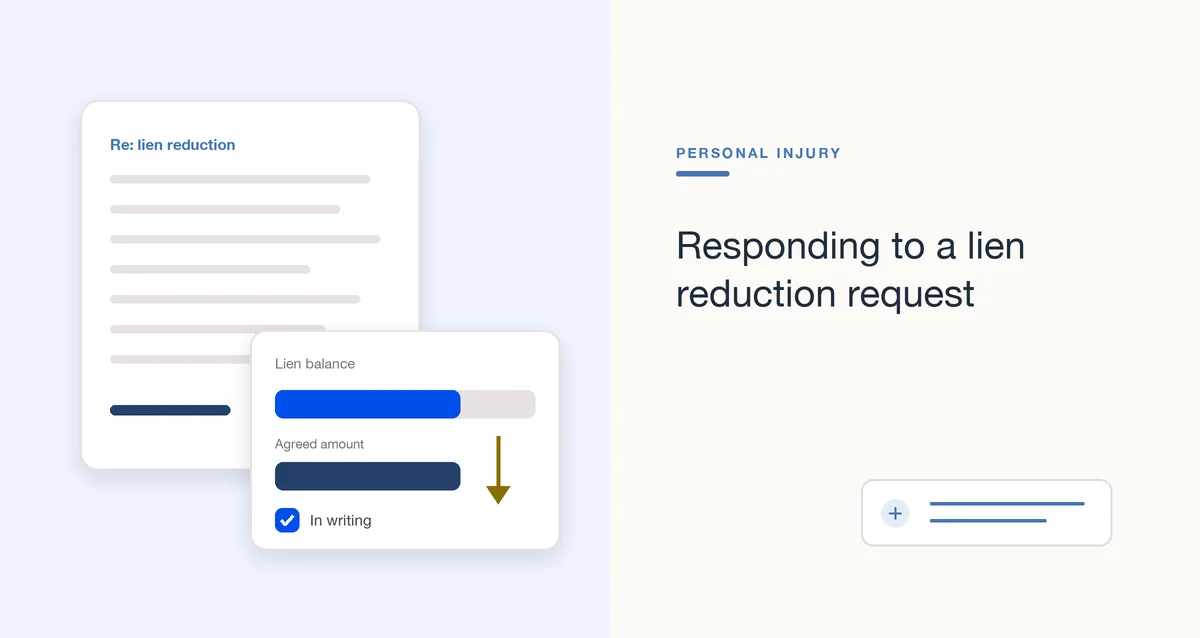
The case is settling, and an email arrives from the patient's attorney: the settlement is smaller than expected, and the firm is asking every medical provider to reduce its lien. Your practice treated the patient for eight months and has waited for payment the whole time. Now you have a few days to decide how much of the balance to give up.
A lien reduction request is one of the most common, and most expensive, moments in personal injury billing. This guide is for practice owners and billing staff: why attorneys ask, what to request before you answer, how to decide, and how to put the agreement in writing. A sample response letter is at the end.
This guide is general information, not legal advice. Lien rules, fee-sharing rules and what a provider may collect from a patient differ by state and by the lien document. Review your process with a licensed attorney in your state.
What is a lien reduction request?
A lien reduction request is a request from the patient's attorney asking a medical provider to accept less than its full balance from the settlement. Attorneys send them when the recovery is too small to pay every lien in full and still leave the patient a reasonable share, or to close the case faster. Accepting is the provider's decision.
The request usually comes near the end of the case, after the settlement amount is known and before the attorney distributes the money. It often goes to every lienholder at once: the treating clinics, any hospital, health insurers and sometimes government payers.
Why do attorneys ask clinics to reduce their liens?
Most requests come from one of a few situations. Knowing which one applies tells you how much room there really is.
- Limited insurance coverage. The at-fault driver's policy limit caps the settlement, and the medical bills alone come close to it.
- Shared fault or a disputed claim. The patient was partly at fault, or liability was contested, so the case settled for less than its full value.
- Several lienholders. Many providers, a hospital and a health insurer all have claims on one settlement.
- Attorney fees and costs. The fee and case costs come out first. In some states, lienholders may be asked to share part of the cost of obtaining the recovery, sometimes called the common fund doctrine.
- Billed versus paid. In states that limit evidence of medical expenses to amounts actually paid, the claimed medical damages may be lower than the billed amount. Florida is an example (Florida Statutes § 768.0427).
- Speed. Sometimes the firm simply wants every lien resolved so it can close the file.
What should a clinic ask for before answering?
Before you agree to any number, ask the firm for the facts behind the request. A reasonable firm will share them, and the answers tell you whether the reduction is fair.
- The gross settlement amount and whether it is final.
- The settlement or closing statement, or at least the attorney fee percentage and case costs.
- Every lien on the case and the reduction each lienholder has been asked for, or has accepted.
- The policy limits, if coverage is the reason for the request.
- The net amount the patient will receive under the proposed split.
- When payment will be sent if you agree.
Then check your own side: the signed lien or letter of protection, the itemized and coded bill, any payments already received, and what your lien document says about the patient's responsibility for an unpaid balance.
How should a clinic decide how much to reduce?
Decide on facts, not on the first number in the email. Weigh what the reduction costs you against the risk and delay of refusing.
| Factor | Points toward a smaller reduction | Points toward a larger reduction |
|---|
| Settlement size | Large settlement relative to all medical bills | Policy-limits settlement that barely covers the bills |
| Other lienholders | Others are not reducing, or reducing little | Everyone is reducing by a similar share |
| Your documentation | Signed lien, itemized and coded bill, clear treatment record | Missing signatures or an incomplete bill |
| Patient's net recovery | The patient still receives a fair share | The patient would receive little or nothing |
| Timing | Payment timing is open-ended | Payment within days if you agree |
| Relationship | One-off firm | A firm that refers regularly and pays reliably |
A common counteroffer is a pro-rata reduction: every lienholder reduces by the same percentage. It is easy to explain and keeps one provider from carrying the shortfall. Another is to accept a reduction only if payment arrives within a set number of days.
Whatever you decide, apply it consistently. A written policy that says who can approve a reduction, up to what percentage, and what documents are required keeps the decision from depending on who opens the email.
How should the agreement be documented?
Put the agreement in writing before the money moves. The agreement should state the original balance, the agreed reduced amount, the deadline for payment, and what happens to the rest of the balance once the reduced amount is paid.
- Make the reduction conditional on payment. If payment does not arrive by the deadline, the full balance stands.
- Be clear about the remaining balance. If you agree to accept the reduced amount as payment in full, say so, and do not bill the patient for the difference. If your lien terms and state law allow a different arrangement, the letter has to say exactly what it is.
- Release the lien only after payment clears, and record the payment and the write-off on the case.
- Keep the whole exchange on the case, including the request, your response, the signed agreement and the payment, so anyone on your team can answer a later question.
Sample lien reduction response letter
Adapt this to your practice and have your attorney review it before use. Text in [brackets] is for you to fill in.
[Practice letterhead]
[Date]
[Attorney name]
[Law firm]
[Address or email]
Re: [Patient name], date of injury [date], our account [number]
Dear [Attorney name],
Thank you for your request of [date] to reduce our lien in this matter. Our current balance is $[amount], as shown on the enclosed itemized statement.
Based on the information you provided (gross settlement of $[amount], attorney fees and costs of $[amount], and the other liens listed), we agree to accept $[reduced amount] in full satisfaction of our lien, on the following conditions:
- Payment of $[reduced amount] is received by [date].
- If payment is not received by that date, this offer expires and the full balance of $[amount] remains due.
- Upon receipt of payment, we will release our lien and will not bill [patient name] for the remaining balance.
Please send payment to [payment instructions] and reference account [number]. If you have questions, contact [name] at [phone or email].
Sincerely,
[Name, title]
[Practice name]
How practices handle lien reduction requests in Ambula
A reduction request is easiest to answer when the lien, the bill and the case history are already together. In Ambula's lien management, part of the personal injury EMR, the signed lien and the referring attorney sit on the patient's case. Every visit and procedure adds itemized charges to the case ledger next to the lien balance. Lien and settlement payments are recorded on the same case.
Case management shows when a case closes, so the billing team can confirm the balance before the reduction request arrives instead of after. Detailed billing reports show what each case has cost and what is still open, which helps when you decide whether a reduction makes sense.
Frequently asked questions
Does a clinic have to accept a lien reduction request?
Usually not. A reduction is a negotiation, and the provider decides whether to accept, counter or decline. Some state statutes cap certain liens, such as California's limit on hospital liens, and some firms will hold disputed funds, so ask an attorney how your state's rules apply before you refuse.
Can a clinic bill the patient for the balance after reducing a lien?
It depends on what you agreed to and on state law. If you accept a reduced amount "in full satisfaction" of the lien, you generally cannot collect the rest from the patient. Make the terms explicit in your written response, and have your lien form and response letter reviewed by an attorney.
How much do clinics usually reduce a lien?
There is no standard percentage. It depends on the settlement amount, the policy limits, the number of lienholders, the attorney fee, and how much the patient would net. Many practices answer with a pro-rata reduction that matches what the other lienholders accept.
What documents should a clinic ask for before agreeing?
Ask for the gross settlement amount, the settlement or closing statement (or at least the attorney fee and costs), a list of all liens and the reductions requested from each, and the payment date. Compare them against your signed lien and itemized bill.
Should a lien reduction always be in writing?
Yes. Confirm the reduced amount, the payment deadline and what happens to the remaining balance in a letter or email the firm acknowledges. Release the lien only after the payment clears, and keep the agreement on the patient's case.
For the basics of how medical liens are signed, secured and paid, see what is a medical lien and the letter of protection guide.
This content is for informational purposes only. Laws governing medical liens, letters of protection and patient balance billing vary by state and are subject to change. Consult a licensed attorney in your jurisdiction for legal guidance specific to your practice.
Sources