
Back to blog
Healthcare EMR Software

EHR vs. EMR: Common Differences and What to Evaluate

Understand the common distinction between EHR and EMR, why product labels vary, and how to compare information exchange and workflow fit.

Mousa Kadaei

Mousa Kadaei

Product & Content Lead, Ambula · 3 min read ·

An older physician with glasses reviews an electronic chart at a desktop computer in an exam room.

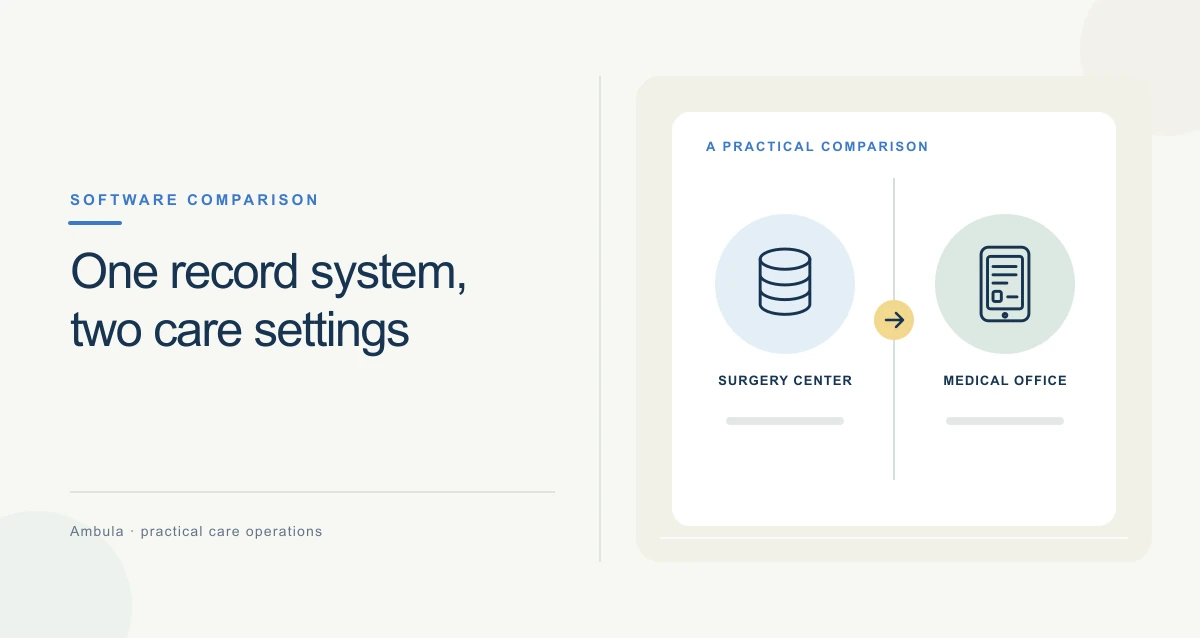
EHR means electronic health record; EMR means electronic medical record. The terms are often used interchangeably in product marketing, but a common distinction is that an EMR refers to a digital chart within a practice, while an EHR is designed to support a broader, longitudinal view and exchange of information across authorized care settings.

The practical distinction

HealthIT.gov describes an EMR as a digital version of a medical office’s paper chart and an EHR as a record built to share information with other healthcare providers, such as laboratories and specialists. This is a useful conceptual difference, not a guarantee about any individual product. Some systems called EMRs offer exchange features; some EHRs may not be connected to every external organization a practice needs. Review the federal explanation of EMR, EHR, and PHR.

Ambula · ASC EMR

One surgical record across the case.

Explore how perioperative documentation can stay organized from scheduling through post-op and billing.

Sample workspace
AmbulaASC charting

ASC charting · sample record

Start with the surgical case

Demo data

Set up the case with its procedure, location, and care-team context.

Procedure
Sample procedure
Location
Operating room 2
Case record
Open

What to compare when selecting software

  • Information exchange: Which data can be sent or received, with whom, and using what interfaces?
  • Clinical workflows: Does it fit the specialty, care setting, documentation, and handoffs?
  • Patient access: What tools help patients view or receive their information, and what alternatives exist?
  • Security and governance: How are permissions, audit trails, data retention, and incidents managed?
  • Implementation and cost: What are the migration, training, support, integration, and contract requirements?

Interoperability is more than a vendor’s claim that its system “connects.” Ask for a demonstration of the exact exchange your organization needs and clarify whether additional products, configuration, or agreements are required.

Choose by workflow, not acronym

Start with a map of how information moves through your practice and where handoffs fail. Then compare systems using the same scenarios and include clinicians, administrative staff, and IT in testing. Ambula describes ASC charting across perioperative stages, but that does not establish exchange with every outside system; demonstrate the specific interfaces your organization needs. The distinction in the name is less important than demonstrated fit, exchange capabilities, and long-term support.

Mousa Kadaei

Written by

Mousa Kadaei

Product & Content Lead, Ambula

Mousa leads product management and content at Ambula. He joined Ambula four years ago as its SEO specialist and now works on how the EMR handles the personal injury case, from intake to settlement. He writes about running a personal injury practice and healthcare digitalization.

One surgical record across the case

Explore perioperative charting, digital consent, and reporting workflows for ambulatory surgery centers.