Updated November 11, 2026. California's SB 623, the Fair Medical Billing & Rideshare Safety Act, was signed on June 25, 2026. For rideshare and app-based driver accident cases arising on or after January 1, 2027, it caps what can be recovered for lien-based medical treatment and voids charges above the cap. It also requires coded, itemized bills, forces disclosure of lien sales, and opens provider referral relationships to discovery.
The law came out of a deal between Uber and the Consumer Attorneys of California that kept two competing measures off the November 2026 ballot. This post covers what it changes for medical practices that treat personal injury patients on a lien.
This is general information, not legal advice. It's based on the legislative analysis and published summaries of the enacted bill. Read the chaptered text and talk to a California attorney about how it applies to your practice.
Which cases does SB 623 cover?
SB 623's medical billing rules apply to civil cases, claims and arbitrations against a network company, its subsidiary or an app-based driver, arising from an automobile accident on or after January 1, 2027, where the injured person was treated by a lien-based provider. In practice, that means accidents involving rideshare and app-based drivers, such as Uber and Lyft drivers.
- Not every car accident. A crash between two private drivers is not covered by these provisions.
- Not past treatment. Medical services rendered, liens created and receivables assigned before January 1, 2027 are excluded.
- "Network company" is defined by reference to California Business and Professions Code section 7463, which covers transportation network companies and delivery network companies.
What does SB 623 change for lien-based providers?
| Change | What it means for the practice |
|---|---|
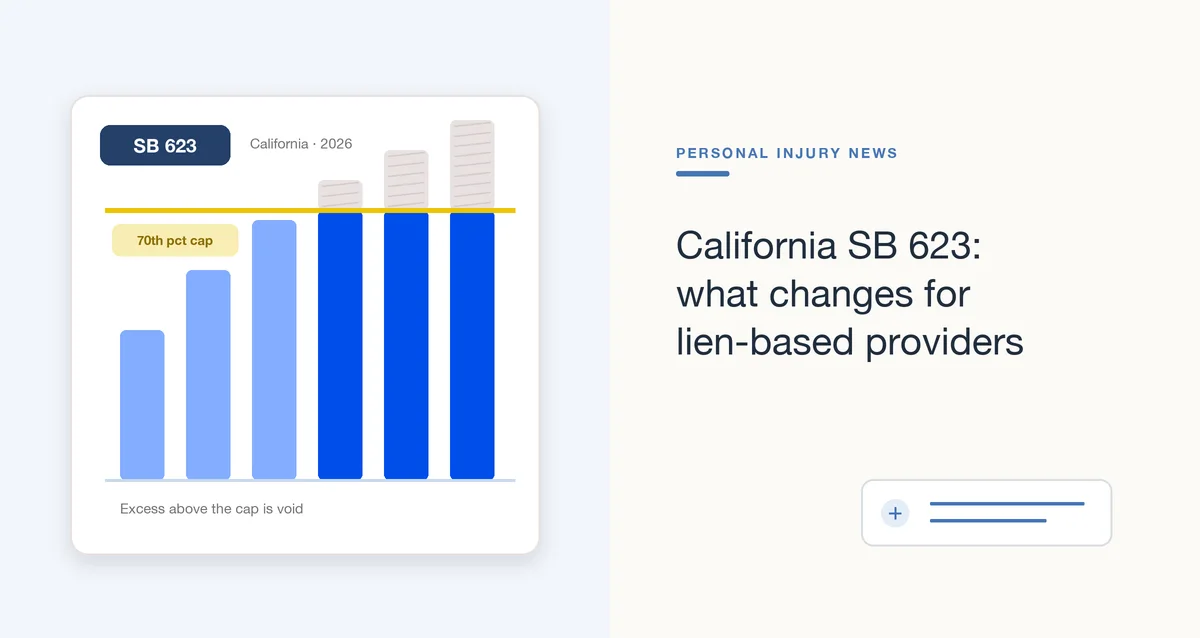
| Cap on recoverable charges | Past medical expenses for lien-based services are generally capped at the 70th percentile of FAIR Health billed charges, or a comparable database, for the same or similar service in the area. Recovery also can't exceed what was actually billed. |
| Charges above the cap are void | Amounts above the maximum are unenforceable, and no one may collect the excess, including from the patient. |
| Narrow exception | A court can allow more before trial, on clear and convincing evidence with expert testimony, for exceptionally rare or highly specialized treatment with no comparable alternative. |
| Coded, itemized bills | Medical expenses are recoverable only with bills itemized at the procedure-code level (CPT, HCPCS and ICD). After a written deficiency notice, there are 30 days to cure. |
| Lien sales disclosed | If a lien or receivable is transferred, the agreement and the price paid must be disclosed within 30 days and before settlement. An undisclosed transfer can't be enforced. A buyer can recover no more than what it paid. |
| Referral relationships are discoverable | Financing, referral, ownership and compensation arrangements between providers and law firms can be explored in discovery. On request, a provider must declare under penalty of perjury whether the plaintiff's counsel referred the patient, and roughly how many patients that attorney or firm referred in the prior 24 months. |
| No pre-agreed reductions | Lien-based providers may not agree, before treatment, to reduce a lien. |
| Attorney restrictions | Attorneys may not refer clients to providers they (or immediate family) directly own, accept kickbacks or referral payments tied to lien-based treatment, or charge extra fees for reducing a client's medical lien. |
What should practices do before January 1, 2027?
- Flag rideshare cases at intake. Ask whether the accident involved a rideshare or app-based delivery driver, and record it on the case. Those cases follow different rules from 2027.
- Make every bill coded and itemized. CPT, HCPCS and ICD codes at the procedure level, for every visit. A bill that can't be itemized on request may not be recoverable.
- Know where your charges sit against the benchmark. Review your lien-based charges for common services against the 70th-percentile benchmark, since anything above it will be void in covered cases.
- Record the referral source on every case. You may have to state under penalty of perjury whether a firm referred the patient and how many patients it referred in the past 24 months. Answer that from your records, not from memory.
- Review any lien sale or factoring arrangements. For covered cases, transfers must be disclosed within 30 days and the buyer's recovery is capped at the price paid, which changes the economics of selling receivables.
- Remove any pre-treatment reduction promises from lien forms and firm agreements used for covered cases.
- Talk to your California attorney about your lien forms, factoring contracts and referral relationships before 2027.