Partway through a case, the patient's attorney asks the treating provider for a "narrative." The chart already holds dozens of visit notes, but the firm wants one document that explains the injury, the care and what comes next, in language an insurance adjuster or a jury can follow. The front desk has to decide who writes it, what it costs and when it goes out.
This guide is for owners, office managers and billing staff at practices that treat personal injury patients. It covers what a narrative report is, what attorneys need in it, how it differs from a records request, and how to set and collect a fee for it.
This guide is general information, not legal advice. Rules for medical reports, records fees and expert testimony differ by state and by court. Confirm your process with a licensed attorney in your state.
What is a narrative report in a personal injury case?
A narrative report in a personal injury case is a written summary, prepared and signed by the treating provider, that explains the patient's injury, the treatment given, the patient's response and the provider's opinions about the future. Attorneys use it to present the medical side of the claim to an insurer, in a demand package or in litigation.
A narrative report is not a copy of the chart. The chart records each visit as it happened. The narrative pulls those visits together into one account and adds opinions that individual visit notes usually do not state, such as whether the accident caused the injury and what care the patient will need later.
What do attorneys need in a narrative report?
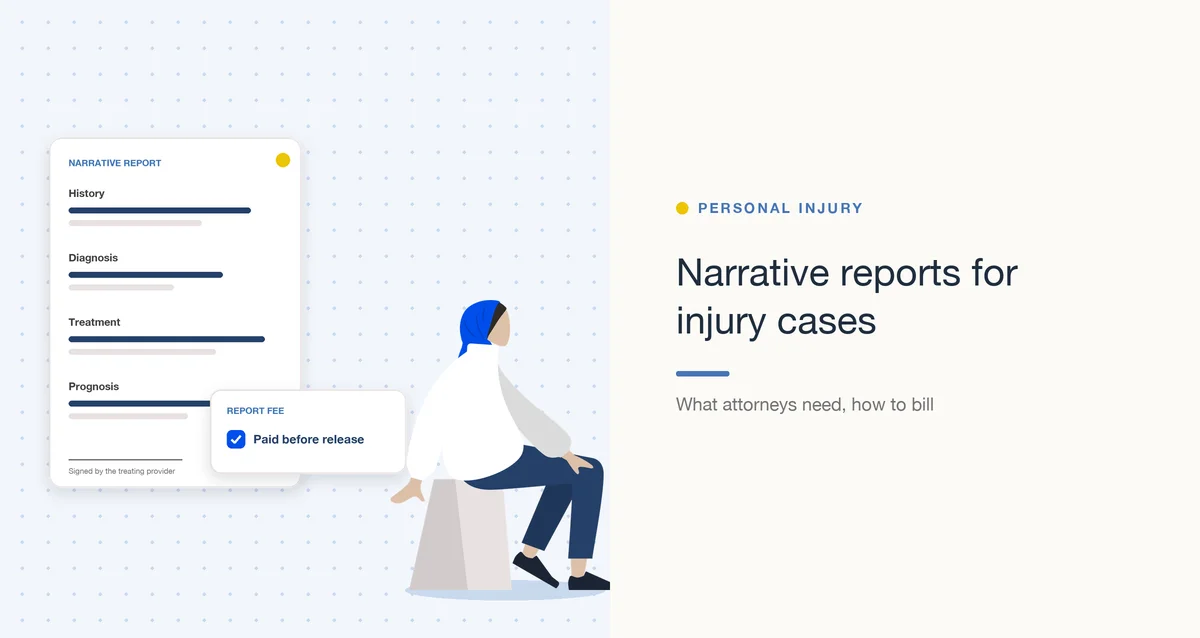
Attorneys need a narrative report to answer the questions an adjuster or the other side will ask: what happened, what was found, what was done, whether it worked and what comes next. Each answer should trace back to the chart. The table below is a checklist practices can use as a template.
| Section | What it covers | Where it comes from in the chart |
|---|---|---|
| History | How the injury happened, the patient's symptoms and relevant prior conditions | Intake forms and the first exam |
| Examination findings | Objective findings at the first visit and at re-exams | Initial and re-examination notes |
| Diagnostic results | Imaging, testing and the provider's interpretation | Imaging and test reports attached to the case |
| Diagnosis | The injuries the provider diagnosed, with codes where useful | Assessment sections of the notes |
| Treatment | Dates, frequency and type of care, plus referrals | Visit and procedure notes |
| Response to treatment | Progress against the baseline, including function, not just pain | Progress notes and outcome measures |
| Causation opinion | The provider's opinion on whether the accident caused or worsened the injury | The provider's own judgment, based on the record |
| Prognosis and future care | Expected recovery, any permanent limits and recommended future treatment | Discharge or most recent re-exam |
| Charges | The itemized bill for the care provided | The case ledger |
The causation and future-care opinions are the provider's to give, and only the provider should sign them. Many states and courts expect medical opinions to meet a stated level of certainty. Ask the attorney which standard applies before the provider writes the opinion sections.
How is a narrative report different from a records request?
A narrative report is a new document the provider writes at the attorney's request, while a records request asks for copies of documents that already exist. That difference changes who does the work, how long it takes and what the practice may charge.
| Records request | Narrative report | |
|---|---|---|
| What is sent | Copies of existing notes, images and bills | A new summary written and signed by the provider |
| Who prepares it | Front desk or records staff | The treating provider, often with staff help |
| Typical fee rules | Copy fees are often set or capped by state law | Usually a professional fee the practice sets, subject to state rules |
| Authorization | A valid HIPAA authorization or other legal basis | The same, plus a clear written request from the firm |
Release of either one still needs a valid legal basis. Under HIPAA, disclosing a patient's information to the patient's attorney usually requires a signed authorization that meets the requirements of 45 CFR 164.508. For the records side, see sending medical records to law firms and the state-by-state guide to records requests.
Who should write the narrative report?
The treating provider should write, or at least review and sign, every narrative report, because the report carries the provider's name and opinions. Staff can assemble the factual sections, such as dates of service, the treatment list and the itemized bill, so the provider spends time only on the findings and opinions.
A narrative report can lead to more requests later, such as a deposition or trial testimony. In federal court, for example, a treating provider who is not specially retained as an expert may still be disclosed as a witness, with a summary of the facts and opinions the provider is expected to give, under Federal Rule of Civil Procedure 26(a)(2)(C). State courts have their own rules. A report written from a complete chart is easier to stand behind if that happens.
How should a practice bill for a narrative report?
Most practices bill a narrative report to the law firm as a flat professional fee, agreed in writing before the provider starts. The fee covers the provider's time to review the chart and write opinions, so it is set separately from records copy fees.
- Publish a fee schedule. List the narrative report fee, the fee for an updated or supplemental report, and the fees for depositions and other testimony, which are usually separate.
- Get a written request and fee agreement. The firm's request should name the patient, the questions the report must answer and who pays.
- Decide when payment is due. Many practices ask for payment before the report is released. Whatever the rule is, apply it to every firm.
- Keep the fee off the treatment lien unless the lien says otherwise. A narrative fee is a charge to the firm for a document, not medical care. If your practice adds it to the lien balance, the lien document and the fee agreement should both say so.
- Check state rules. Some states regulate charges for medical reports or records. Confirm what applies in your state before setting the fee.
A CPT code exists for special reports: 99080, described as special reports "more than the information conveyed in the usual medical communications or standard reporting form." Most payers do not cover it, according to the American Academy of Ophthalmology's coding guidance, so in a personal injury case the narrative is normally billed to the firm, not to insurance.