Last verified November 23, 2026. "Paid vs. billed" laws decide which number a jury sees when an injured patient claims medical expenses: the amount the practice billed, or the amount that was actually paid or owed. These laws matter most to practices that treat personal injury patients on a lien or a letter of protection (LOP), where there is no insurer payment to point to.
This tracker lists the states with an enacted law or a recent bill on paid vs. billed evidence and letter of protection disclosure, with each law's status, what it changes and a link to the official text. We'll update it as states act.
General information, not legal advice. Rules differ by state and change often; confirm how they apply to your practice with a licensed attorney in your state.
What does "paid vs. billed" mean?
"Paid vs. billed" is the gap between a practice's full charge for a service and the amount that actually settles the bill. When a health plan pays a discounted rate, the paid amount is lower than the billed amount. Many states have long let injured patients claim the full billed amount. Paid vs. billed laws limit the claim, or the evidence, to amounts paid or owed.
For a practice treating on a lien, the change shows up as questions about the bill: what each line is, how it's coded, whether the patient had insurance, and whether the receivable was sold. A medical lien or letter of protection is still a valid way to be paid. What changes is how the bill is tested in the case.
Which states have paid vs. billed laws in 2026?
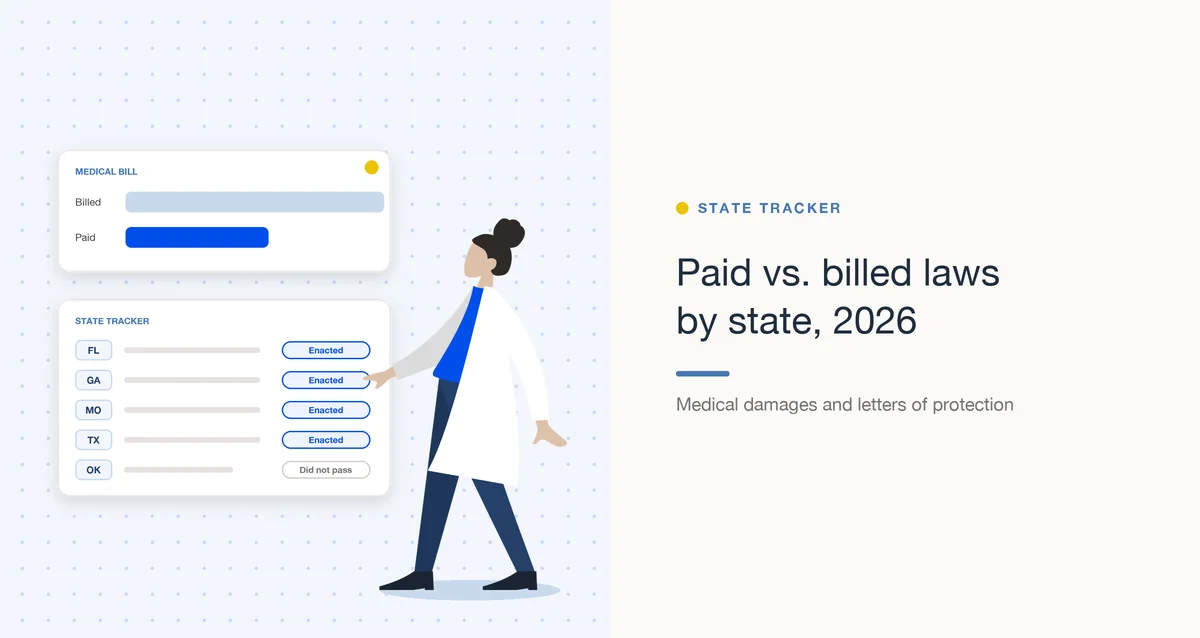
Florida, Georgia, Missouri and Texas have enacted laws that tie medical damages evidence to amounts paid or owed. Florida and Georgia also require letter of protection details to be disclosed. Oklahoma and Texas considered broader bills in 2025 and 2026 that did not pass. Each row below links to the statute or the official bill page, checked on November 23, 2026.
| State | Law or bill | Status (checked Nov 23, 2026) | What it changes for medical damages | Applies from | Source |
|---|---|---|---|---|---|
| Florida | HB 837 (2023), Fla. Stat. § 768.0427 | Enacted, in force | Paid bills are proven by the amount actually paid. Unpaid bills can be measured by what the patient's health coverage would pay, or 120% of Medicare for patients without coverage. LOP cases must disclose the LOP, itemized coded bills, any factoring sale and price, the patient's coverage and the referral source. | Signed March 24, 2023 (ch. 2023-15). The act generally applies to cases filed after that date. | Fla. Stat. § 768.0427 (2026) |
| Georgia | SB 68 (2025), O.C.G.A. § 51-12-1.1 | Enacted, in force | Medical damages are limited to the reasonable value of medically necessary care. If the patient has insurance, the evidence includes both the amounts charged and the amounts needed to satisfy them under the plan. In LOP cases, the LOP, itemized coded charges, any sale of the receivable and its price, and the referral source are discoverable. | Causes of action arising on or after April 21, 2025 | SB 68, House substitute LC 49 2362S (as passed) |
| Missouri | SB 31 (2017), RSMo § 490.715 | Enacted, in force | Parties may introduce the "actual cost" of medical care: the amounts paid plus any balance still owed after contractual discounts, price reductions or write-offs. The statute has no letter of protection provision. | August 28, 2017 | RSMo § 490.715 |
| Texas | Tex. Civ. Prac. & Rem. Code § 41.0105 | Enacted, in force | Recovery of medical expenses is limited to the amount "actually paid or incurred" by or for the claimant. | September 1, 2003 | CPRC § 41.0105 |
| Texas | SB 30 (2025), companion HB 4806 | Did not pass. Last action May 30, 2025: House appointed conferees. | Would have limited the evidence used to prove health care expenses, defined letters of protection and required claimants to disclose them. | Not in effect | Texas Legislature: SB 30 history |
| Oklahoma | SB 2166 (2026) | Did not pass. Placed on the Senate General Order on February 26, 2026; no final vote before the session ended. | Would have capped medical damages at amounts actually paid, made billed amounts inadmissible and added letter of protection disclosure rules. | Not in effect | Oklahoma Legislature: SB 2166 |
Rows list only what we could confirm in the statute text or on the legislature's own bill page. In many other states, courts decide paid vs. billed questions under the collateral source rule rather than a statute, and those rules are not in this table.
Which states should practices watch next?
Louisiana and Utah have reported 2025 and 2026 activity that we could not yet confirm in the enacted text for this edition. They are listed here so you know to check, not as settled law.
- Louisiana. The Legislature's 2025 civil law update lists Act 466 (SB 231) as amending R.S. 9:2800.27 on recoverable medical expenses, effective January 1, 2026. A 2026 bill, HB 1002, proposed letter of protection rules. Check the enacted text and the bill's final status before relying on either.
- Utah. SB 280 (2026) was introduced with paid vs. billed and letter of protection disclosure provisions. We could not confirm whether it passed.
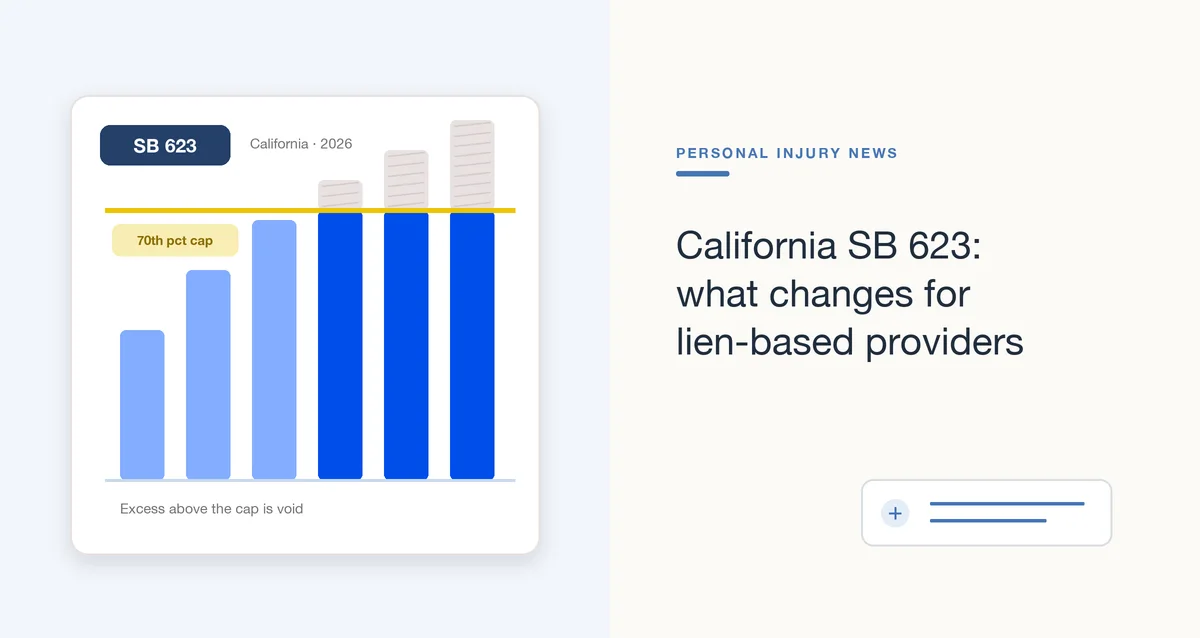
- California. SB 623 caps lien-based charges in rideshare accident cases from 2027. It works through a benchmark cap rather than a paid vs. billed rule. See our SB 623 guide for lien-based providers.
What do these laws change for a practice treating on a lien?
Paid vs. billed laws move attention from the total on the bill to the details behind it. In Florida and Georgia, a claim for treatment under a letter of protection depends on records the practice creates: the signed LOP, itemized coded bills and any sale of the receivable. Missing or vague records make the bill harder to defend.
| What the law looks at | Where it appears | What the practice should have ready |
|---|---|---|
| A copy of the letter of protection | Florida, Georgia | The signed LOP or lien, stored on the patient's case |
| Itemized, coded bills | Florida (CPT, HCPCS or ICD, by setting), Georgia (generally accepted billing practices) | A line-item bill with codes for every visit and procedure |
| Sale of the receivable | Florida, Georgia | The buyer's name and the price paid, if the lien was factored |
| The patient's health coverage | Florida, Georgia | Whether the patient had insurance at the time of treatment, recorded at intake |
| The referral source | Florida, Georgia | Who referred the patient, recorded on every case |
| Amounts paid or still owed | Florida, Georgia, Missouri, Texas | A ledger showing charges, payments, reductions and the balance |