Published November 13, 2026. This is the first Ambula monthly update for practices that treat personal injury patients: chiropractors, physical therapists, pain management, orthopedic and neurology practices, imaging centers and surgery centers. Because it's the first issue, it covers the 2026 changes that still matter now, not just the last 30 days. Each item says what changed, who it affects and what to do, and links to the official source.
This is general information, not legal advice. Talk to an attorney in your state about how a change applies to your practice.
What changed for medical liens in 2026?
Four changes affect how lien-based practices get paid: a new California law for rideshare cases, a strict Arizona ruling on lien content, a Georgia Supreme Court decision on lien forms, and a New Jersey ruling that can lower the value of auto cases.
California: SB 623 caps lien-based charges in rideshare cases from January 1, 2027
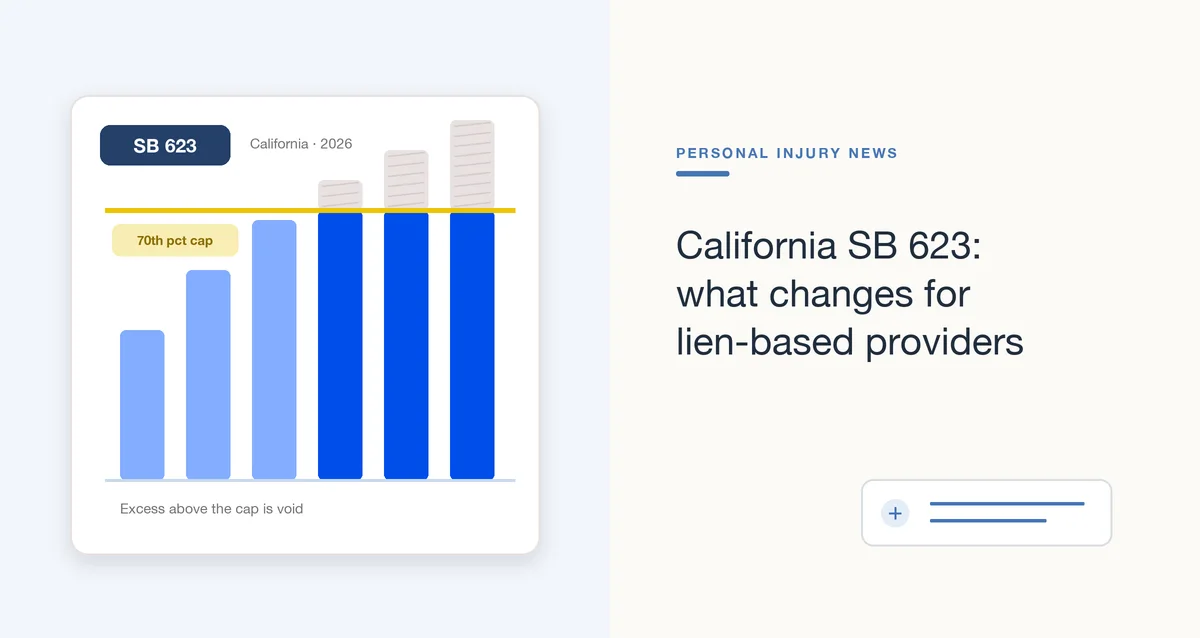
SB 623 (Ch. 17, Stats. 2026) was approved on June 25, 2026 and adds Civil Code § 3333.9. It applies only to claims against a rideshare or delivery network company or an app-based driver, from accidents on or after January 1, 2027. It caps recoverable lien-based medical charges, voids charges above the cap, and requires a lien sale to be disclosed within 30 days and before any settlement is paid out. Treatment, liens and sold receivables from before 2027 are excluded.
Who it affects: any California practice that treats rideshare or app-driver accident patients on a lien. Read the full breakdown in what SB 623 changes for lien-based providers.
Arizona: every lien must say whether treatment has ended or is continuing
In HonorHealth v. Abboud (Feb. 24, 2026), the Arizona Court of Appeals held that every recorded lien, from hospitals and all other providers, must include a separate statement of whether treatment has ended or is continuing. Listing dates of service is not enough, and substantial compliance is not enough. A petition for review is pending in the Arizona Supreme Court (No. CV-26-0092-PR), so this could change.
Who it affects: Arizona practices that record liens. Check your lien template now. See the Arizona lien guide.
Georgia: a signed "doctor's lien" form may not protect the bill
In In re Ferguson, 324 Ga. 222 (Apr. 21, 2026), a patient and attorney both signed a chiropractor's lien form, and the attorney did not pay from the settlement. The Georgia Supreme Court held the State Bar had not proved a rule violation: the attorney could reasonably read the form as an attempted statutory lien that was never perfected. The Court also confirmed chiropractors had no Georgia lien rights before SB 168 took effect in 2023.
Who it affects: Georgia practices that rely on lien forms. Follow every statutory step to perfect a lien, and get the attorney's written agreement to pay from the settlement as a separate document. See the Georgia lien guide.
New Jersey: future medical costs within PIP limits are out of auto cases
In Murray v. Punina, 264 N.J. 1 (May 6, 2026), the New Jersey Supreme Court held that future medical expenses within PIP limits are "collectible" and can't be presented to the jury under N.J.S.A. 39:6A-12. The Court removed the future-medical award in that case.
Who it affects: New Jersey practices treating auto accident patients. Some cases may settle for less, which affects how much of a lien balance is realistic. See the New Jersey lien guide.
What changed for medical records requests in 2026?
Federal enforcement kept going, a federal rule for substance use disorder records became mandatory, and two states published new copy-fee caps.
HIPAA: the 56th Right of Access enforcement action
On October 8, 2026, the HHS Office for Civil Rights announced a $140,000 settlement with a Pennsylvania dental practice that did not give a patient timely access to records. It was OCR's 56th Right of Access enforcement action. HIPAA gives a practice 30 days to act on a patient's request, with one 30-day extension only if the patient gets written notice of the reason and new date before the first 30 days run out.
Part 2: substance use disorder records rule is now enforced
Compliance with the updated 42 CFR Part 2 rule became mandatory on February 16, 2026, and HHS civil enforcement started the same day. If your practice receives substance use disorder records covered by Part 2, those records need their own consent before you send them to an attorney or insurer.
Illinois and Pennsylvania: new 2026 copy-fee caps
| State | 2026 maximum fees for attorneys and other third parties | Source |
|---|---|---|
| Illinois | $36.68 handling charge, plus $1.38 per page for pages 1 to 25, $0.92 for pages 26 to 50 and $0.46 after page 50. Electronic copies: 50% of the paper per-page charge. | Illinois Comptroller |
| Pennsylvania | $2.00 per page for pages 1 to 20, $1.48 for pages 21 to 60 and $0.52 after that, plus a $29.61 search and retrieval fee that can't be charged to patients asking for their own records. | 55 Pa.B. 8441 |
A patient's own request follows HIPAA's cost-based fee rules instead of these caps. Compare all 10 states in the records requests research.