
Back to blog
Medical Billing

Prior Authorization for Pain Management Procedures: Rules and Workflow

When injections, facet procedures and ablation need prior authorization, what the 2026 CMS rule changed, what payers ask for, and a step-by-step workflow to avoid denials.

Mousa Kadaei

Mousa Kadaei

Product & Content Lead, Ambula · 5 min read ·

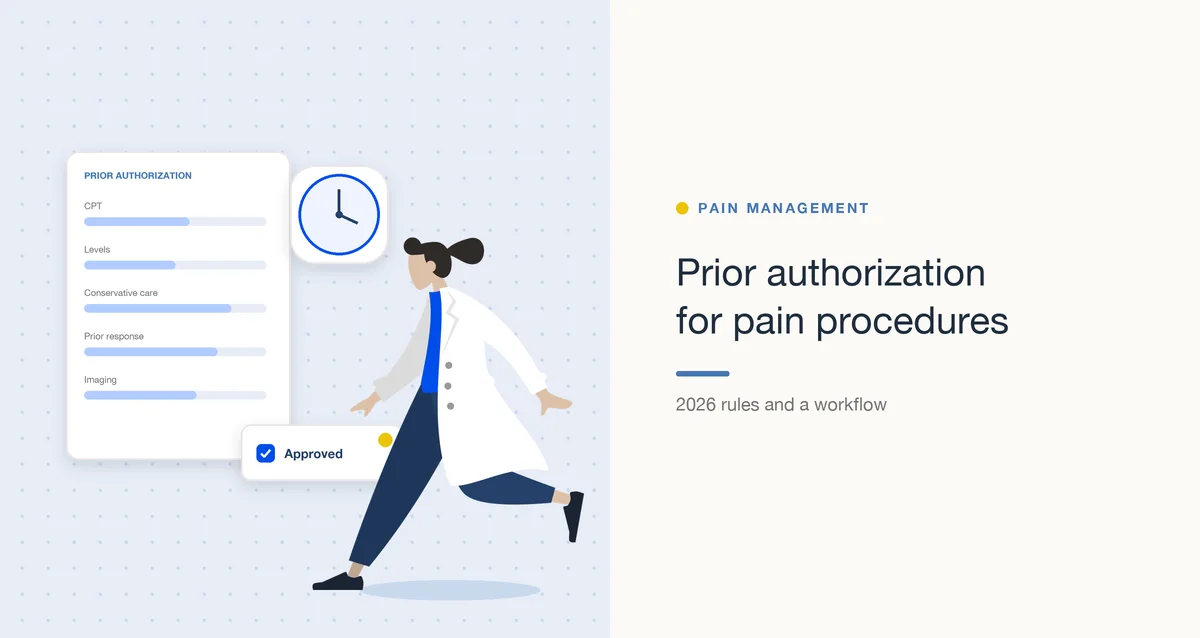
Illustration of a prior authorization request form with procedure codes, a decision clock and an approved stamp.

Epidural steroid injections, facet joint procedures, radiofrequency ablation and spinal cord stimulators often need prior authorization before an insurer will pay. For a pain management practice, a missed or late authorization means a delayed procedure or an unpaid claim. This guide covers when authorization is needed, the federal rules that changed in 2026, what payers ask for, and a workflow that keeps requests moving.

This is general information about billing workflows. Coverage rules differ by payer and plan; always check the patient's specific plan.

What is prior authorization?

Prior authorization is a payer's approval, given before a service is performed, that the service is covered for that patient. Payers use it most for higher-cost services and those with set coverage criteria. In pain management that typically includes interventional spine procedures, some imaging and some medications. Without it, the payer can deny the claim even when the procedure was appropriate.

Which payers require it?

  • Commercial plans and Medicare Advantage: most require authorization for interventional pain procedures. Each plan publishes its own list of services and criteria.
  • Medicaid: requirements vary by state program and managed care plan.
  • Traditional Medicare: generally doesn't use prior authorization, with exceptions. Since July 1, 2023, facet joint interventions performed in hospital outpatient departments need prior authorization as a condition of payment (CMS, prior authorization for certain hospital outpatient department services). Coverage is also governed by local coverage determinations (LCDs), which set documentation criteria.
  • Personal injury patients on a lien: no insurer authorization is involved, but the attorney and insurer will still review whether each procedure was needed. Document it to the same standard.

What changed in 2026?

The CMS Interoperability and Prior Authorization Final Rule (CMS-0057-F) applies to Medicare Advantage organizations, Medicaid and CHIP programs and their managed care plans, and Qualified Health Plan issuers on the federal exchanges. It does not cover prior authorization for drugs. Since January 1, 2026, those payers must:

  • Decide faster: within 72 hours for expedited (urgent) requests and 7 calendar days for standard requests. The 7-day standard doesn't apply to exchange plans.
  • Explain denials: give a specific reason for every denied request.
  • Report metrics: publish prior authorization statistics each year.

From January 1, 2027, those payers must also offer a Prior Authorization API, so requests and decisions can move electronically between practice systems and payers. Employer plans and traditional Medicare aren't covered by these requirements.

What it means for your practice: track the date each request is sent. If a covered payer goes past the deadline, follow up and escalate. Use the specific denial reason to fix the request or appeal.

What do payers usually ask for?

Criteria differ by payer and procedure, but requests for interventional pain procedures commonly need:

  • Diagnosis and symptom history: where the pain is, how long it has lasted and how it affects function.
  • Conservative care tried first: physical therapy, medications, activity changes, with dates and results.
  • Imaging and exam findings that support the planned procedure.
  • Pain and function scores measured with consistent scales.
  • For repeat procedures: the documented response to earlier procedures, such as how much relief and for how long. Many payer policies and LCDs require this before approving another injection or ablation.
  • Procedure details: CPT codes, levels, side, number of units and the planned date and place of service.

The strongest requests come from charts that already capture this at every visit, so staff don't have to rebuild the history from scattered notes.


A prior authorization workflow for pain practices

  1. Check at scheduling. When a procedure is planned, check the patient's plan for authorization requirements for that CPT code and place of service.
  2. Gather the documentation listed above from the chart.
  3. Submit through the payer's portal or required method, and record the date, method and reference number.
  4. Track the deadline for each payer type, and follow up when it passes.
  5. Record the decision: authorization number, approved codes and units, valid dates and place of service.
  6. Schedule within the valid window, and recheck if the date, codes or location change.
  7. If denied: read the specific reason, request a peer-to-peer review if offered, and appeal with the missing documentation.

Common reasons requests are denied or claims fail

  • Conservative care not documented, or not long enough for the payer's criteria.
  • No documented response to an earlier injection before a repeat procedure.
  • Code or level mismatch between the authorization and the procedure performed.
  • Expired authorization because the procedure was rescheduled outside the valid dates.
  • Wrong place of service, for example approved for an office but performed at a surgery center.

What about patients with both insurance and an injury claim?

If an accident patient's procedures are billed to their health plan, the plan's authorization rules apply as usual. If the patient is treated on a lien, there's no authorization step, but the same documentation decides whether the attorney and insurer accept the procedure as necessary. Recording conservative care, pain and function, and the response to each procedure serves both. See running insurance and personal injury patients in one pain practice and documenting injections for an injury case.

Ambula's pain management EMR keeps procedure templates, pain scales, functional outcomes and relief duration in one chart, so the history a payer or attorney asks for is already there. Authorization numbers and dates can be recorded on the patient's record alongside the planned procedure.

Frequently asked questions

How long does prior authorization take?

It depends on the payer. Under the CMS rule, Medicare Advantage, Medicaid and CHIP payers must decide within 72 hours for expedited requests and 7 calendar days for standard requests. Other plans set their own timelines.

Does an approved authorization guarantee payment?

An approved prior authorization does not guarantee payment. The claim must still match the authorization (codes, units, dates and place of service), and the payer can still deny it for other reasons, such as eligibility or documentation.

Do personal injury patients need prior authorization?

Not when they're treated on a lien or letter of protection, because no health plan is paying. If their health insurance is billed, the plan's normal rules apply.

Who should handle prior authorizations in a pain practice?

Most practices assign it to one or two trained staff members who know each major payer's rules, with a prescriber available for peer-to-peer reviews.

Does the CMS rule cover medications?

The CMS prior authorization rule does not cover medications. The decision timeframes and denial-reason requirements in CMS-0057-F apply to medical items and services, not prior authorization for drugs.

Mousa Kadaei

Written by

Mousa Kadaei

Product & Content Lead, Ambula

Mousa leads product management and content at Ambula. He joined Ambula four years ago as its SEO specialist and now works on how the EMR handles the personal injury case, from intake to settlement. He writes about running a personal injury practice and healthcare digitalization.

Built around the case, not the visit

Intake, charting, orders, records and lien billing for personal injury clinics, in one system.