Back to blog
Personal Injury

Personal Injury Intake Checklist: What to Collect Before the First Visit

What a personal injury practice should collect and verify at intake: accident details, prior injuries, the attorney and firm, coverage, and signed consent, lien and records authorization forms.

Mousa Kadaei

Mousa Kadaei

Product & Growth Manager, EMR · 6 min read ·

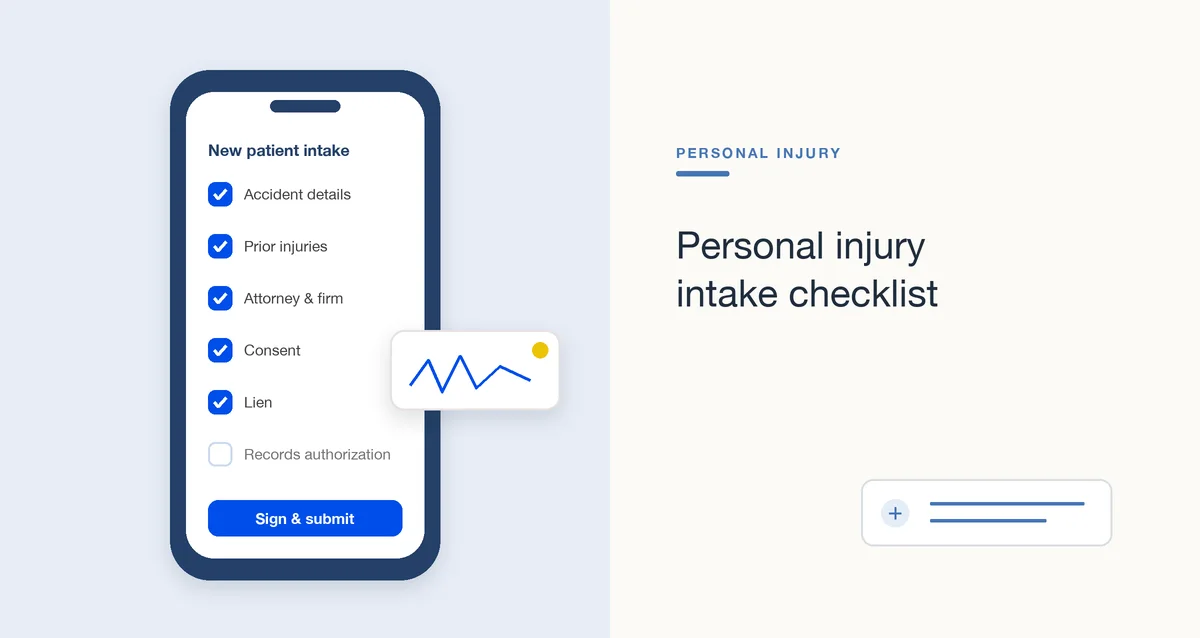
Illustration of a phone showing a new patient intake checklist and a signature.

Most problems in a personal injury case start at the front desk. A lien nobody signed, an attorney who turns out not to represent the patient, a missing date of injury, a records request with no authorization behind it. Each one is cheap to prevent on day one and expensive to fix at settlement.

This personal injury intake checklist is for front desk staff, office managers and practice owners. It covers what to collect before or at the first visit, why each item matters later, and what to verify before you treat on a lien.

This is general information, not legal advice. Intake forms, lien terms and consent requirements vary by state and practice. Have your forms reviewed by a licensed attorney in your state.

What should a personal injury intake collect?

A personal injury intake should collect the accident details, the injuries and symptoms in the patient's words, prior injuries and treatment, the attorney and law firm, any insurance or claim information, and signed consent, lien and records authorization forms. Collect it before the first visit if you can, so the first exam starts from a complete case.

The personal injury intake checklist

CollectDetailsWhy it matters later
Patient demographicsLegal name, date of birth, contact details, preferred contact methodEvery record, bill and release has to match the right patient
Accident detailsDate of injury, type of accident, how it happened, where they were in the vehicle, police report number if anyTies treatment to the injury claimed in the case
Rideshare or delivery driver involved?Yes or no, and which companySome states now apply different rules to these cases, such as California SB 623 from 2027
Symptoms and limitationsWhere it hurts, when symptoms started, what the patient can no longer doSets the baseline that every later visit is compared with
Prior injuries and treatmentEarlier injuries or treatment to the same body area, other providers seen since the accidentThe other side will look for pre-existing conditions. Better to know first.
Attorney and law firmAttorney name, firm, case manager, phone and emailRequests, updates and payment all go through the firm
Claim informationAuto insurer, claim number, adjuster contact if knownNeeded for records requests and some billing
Health coverageHealth insurance, and any auto medical coverage such as PIP or MedPayDecides how the visit is billed, and some states require disclosure of coverage in lien cases
Signed consent to treatYour standard consent formsRequired before treatment
Signed lien or letter of protectionThe patient's signature, plus the attorney's if your form requires itThe basis for waiting to be paid from the settlement
Records authorizationA HIPAA authorization naming the law firm, what may be shared, and an expirationA lien is not a records release. Without the authorization you can't send records to the firm.
Financial terms and attendance policyWhat the patient owes if the case is lost or dropped, and the missed-visit policy, both acknowledged in writingAvoids disputes at the end of the case

What should staff verify before treating on a lien?

Before the first visit on a lien, confirm that the attorney actually represents the patient, that the lien is signed by everyone your form requires, and that the records authorization names the right firm. Five minutes of checking at intake prevents months of chasing later.

  • Representation. Ask the firm to confirm in writing that it represents the patient for this accident, and get the case manager's direct contact.
  • Signatures. Check that the patient, and the attorney if required, have signed the lien or letter of protection. A lien missing a signature is a weak position at settlement.
  • Authorization scope. Make sure the HIPAA authorization names the firm and covers the records the firm will ask for (45 CFR 164.508).
  • Coverage. Verify any health insurance or auto medical coverage the patient has, so billing decisions are made on day one.
  • Referral source. Record who referred the patient. In Florida, for example, a claimant treated under a letter of protection must disclose whether they were referred and by whom (Florida Statutes § 768.0427).


Ambula personal injury EMR · Sample intake

A complete case before the first visit.

Follow a sample intake: the patient completes forms on a phone, the attorney is attached, and the front desk sees what is still unsigned.

AmbulaPersonal injury · Intake
Sample record

AT HOME · SAMPLE DATA

The patient completes intake on a phone

01 / 03

Accident details, symptoms and prior injuries are entered in the patient's own words, and consent and lien forms are signed.

  • Accident detailsCompleted · sample
  • ConsentSigned
  • LienSigned by patient
Illustrative workflow · no patient data

Illustrative workflow only. Required forms and lien terms vary by state and practice. This is not legal advice.

Should intake happen before the first visit?

Yes, when possible. When patients complete intake on their phone before they arrive, the history is in their own words, signatures are collected before treatment, and staff check a completed packet instead of retyping a paper one. It also gives the front desk time to call the firm if something is missing.

Paper intake still works, but it tends to fail at the same points: an unsigned page, an illegible attorney name, or a form that never makes it into the chart.

What are the most common intake mistakes in personal injury cases?

  1. Treating before the lien is signed. Hard to fix later, and sometimes impossible.
  2. No records authorization. The firm asks for records, and the practice can't legally send them yet.
  3. The wrong attorney on file. The patient changed firms, or gave the name of a firm they only called once.
  4. Vague accident details. No date of injury, or a description that doesn't match the injuries treated.
  5. Missing prior history. A prior injury to the same area surfaces in a deposition, not at intake.
  6. No written financial terms. Nobody explained what happens if the case is lost or dropped.

How practices run personal injury intake in Ambula

In Ambula's personal injury EMR, patients complete digital intake on their phone before the first visit. They describe the accident and their symptoms, and sign consent and lien forms. Practices build their own intake packets in the form builder, so questions like "Did the accident involve a rideshare or delivery driver?" can be added without coding.

The referring attorney is attached to the case from day one, and attorneys can sign liens in the Lawyer Portal. The lien report lists every case where the patient or the attorney hasn't signed yet, so the front desk can fix it before treatment goes further. Practices that also see insurance patients run them in the same system.

Frequently asked questions

What forms does a personal injury patient need to sign?

Usually a consent to treat, a lien or letter of protection, a HIPAA authorization that lets the practice share records with the law firm, and an acknowledgment of the financial terms and attendance policy. The exact set depends on your state and practice. Have your forms reviewed by an attorney.

Should a practice treat a personal injury patient before the lien is signed?

It's risky. Without a signed lien or letter of protection, the practice may have no clear right to be paid from the settlement. Many practices require the patient's signature, and the attorney's if their form requires it, before the first billable visit.

How do you verify that an attorney represents the patient?

Ask the law firm to confirm representation in writing for this specific accident, and record the attorney, firm and case manager on the patient's case. If the patient later changes firms, update the case and get the new firm's acknowledgment of your lien.

Why ask about prior injuries at intake?

The defense will look for pre-existing conditions to the same body area. Recording prior injuries and treatment at intake lets the clinician document how the current injury differs, rather than being surprised by it later in the case.

Is a lien the same as permission to send records to the attorney?

No. A lien is a payment arrangement. Releasing records to the patient's attorney generally requires a valid HIPAA authorization signed by the patient (45 CFR 164.508), so collect it at intake with the lien.

This content is for informational purposes only. Requirements for consent, liens, letters of protection and records release vary by state. Consult a licensed attorney in your jurisdiction for guidance specific to your practice.

Sources

Mousa Kadaei

Written by

Mousa Kadaei

Product & Growth Manager, EMR

Mousa is a product and growth manager at Ambula. He designs products around what doctors need and writes about healthcare technology.

Built around the case, not the visit

Intake, charting, orders, records and lien billing for personal injury clinics, in one system.