Surgery center billers work with two claim forms. Medicare wants the facility claim in the professional format, while some commercial, Medicaid and auto payers ask for a UB-04. Personal injury cases add a third reader: the patient's attorney, who receives the facility bill and compares it with the operative report at settlement.
This UB-04 guide is for billers, administrators and owners of ambulatory surgery centers (ASCs). It explains when a surgery center uses the UB-04 at all, walks through the form locators that matter on an outpatient surgery claim, and covers the type of bill, revenue codes and accident codes that trip up ASC claims most often.
This is general billing information, not legal or payer-specific advice. The type of bill, revenue codes and form requirements an ASC uses are set by each payer's contract and manual. When they differ from this guide, follow the payer.
What is the UB-04 form?
The UB-04, also called Form CMS-1450, is the standard paper claim form for institutional providers: hospitals, surgery centers and other facilities billing for the facility's part of the care. It has 81 boxes called form locators (FLs). Its electronic equivalent is the 837 institutional transaction (837I).
The UB-04 code sets (type of bill, revenue, condition, occurrence and value codes) are maintained by the National Uniform Billing Committee (NUBC) in its licensed data specifications manual. Medicare's public instructions for each form locator are in Chapter 25 of the CMS Medicare Claims Processing Manual.
Does a surgery center bill on the UB-04 or the CMS-1500?
A freestanding surgery center bills Medicare on the 837 professional format, or in rare cases the paper CMS-1500, with place of service 24, not on the UB-04. Some commercial, Medicaid and auto payers ask ASCs for a UB-04 instead. The payer's contract or provider manual decides which form each claim uses.
| Who you bill | Facility claim form | What to check |
|---|---|---|
| Medicare (freestanding ASC) | 837P or CMS-1500 | Place of service 24. Since January 1, 2008, Medicare no longer requires the SG modifier on ASC facility claims. |
| Commercial plans | UB-04 or CMS-1500, by contract | The contract names the form, the type of bill and any required revenue codes |
| Medicaid | Set by each state | Your state Medicaid provider manual for ASCs |
| Auto insurers | Varies by insurer and state | Ask the adjuster which form and codes they process |
| Personal injury on a lien | No payer claim; a facility bill for the attorney | Send a completed UB-04 or an itemized bill with the records; ask the firm which it wants |
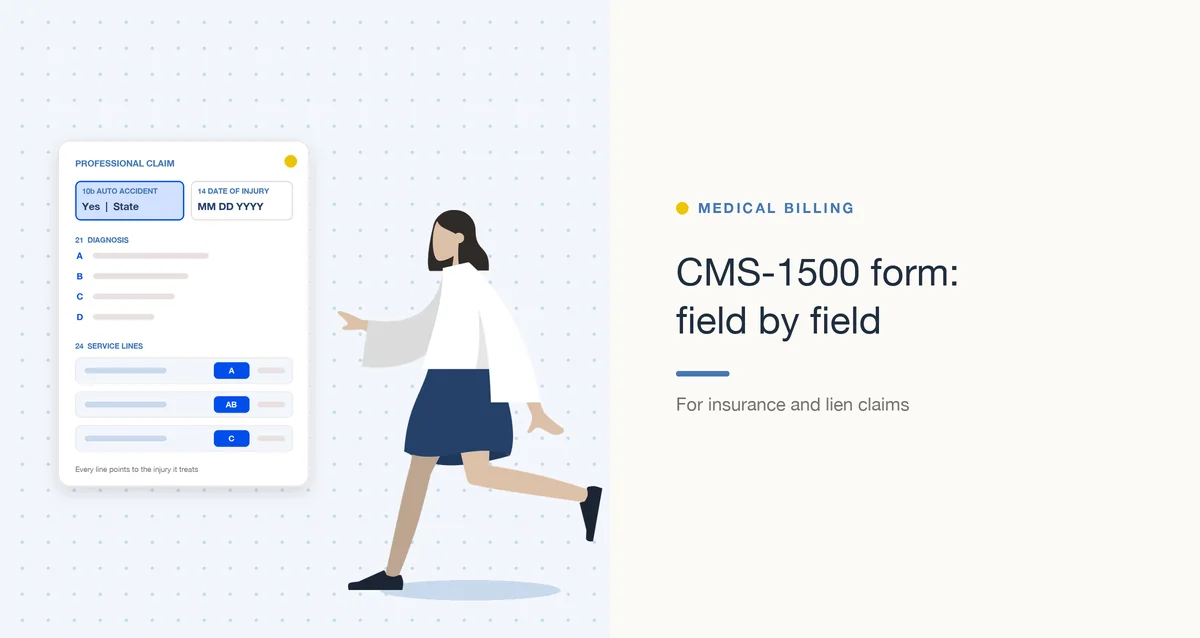
The surgeon's and anesthesia provider's professional services are billed separately, on the CMS-1500. Our CMS-1500 field-by-field guide covers that form.
Which UB-04 form locators matter on a surgery center claim?
An outpatient surgery claim uses only part of the UB-04. Inpatient fields such as admission hour, occurrence spans and principal procedure are left blank, and Medicare ignores several boxes entirely. The table covers each form locator group and what an ASC enters there, based on CMS's Chapter 25 instructions.
| FL | Field | What goes there | Surgery center note |
|---|---|---|---|
| 1 | Billing provider | Facility name, address with 9-digit ZIP, and phone | The surgery center, not the surgeon |
| 2 | Pay-to provider | Only if payment goes to a different address; Medicare ignores it | |
| 3a, 3b | Patient control number, medical record number | Your account number (3a, required) and chart number (3b) | Use the case or account number your team searches by |
| 4 | Type of bill | 4-digit code: leading 0, facility type, classification, frequency | See the type of bill section below |
| 5 | Federal tax number | The facility's EIN (NN-NNNNNNN) | |
| 6 | Statement covers period | From and through dates of the services on this bill (MMDDYY) | For a single procedure, both dates are the surgery date |
| 8 to 11 | Patient name, address, birth date, sex | As on the patient's record; birth date in 8 digits | |
| 12, 13, 16 | Admission date, admission hour, discharge hour | Admission date is for inpatient and home health; Medicare doesn't require the hours | Usually blank on an outpatient surgery claim unless the payer asks |
| 14, 15 | Priority of visit, point of origin | NUBC codes for the type of visit and the source of the referral | Required by Medicare on institutional claims; use your payer's code list |
| 17 | Patient discharge status | NUBC code for where the patient went after care | Most surgery center patients are discharged home |
| 18 to 28 | Condition codes | Codes for conditions that apply to the bill, in numeric order | Only when one applies |
| 29 | Accident state | 2-letter state where an accident happened | Not used by Medicare; some auto and liability payers want it |
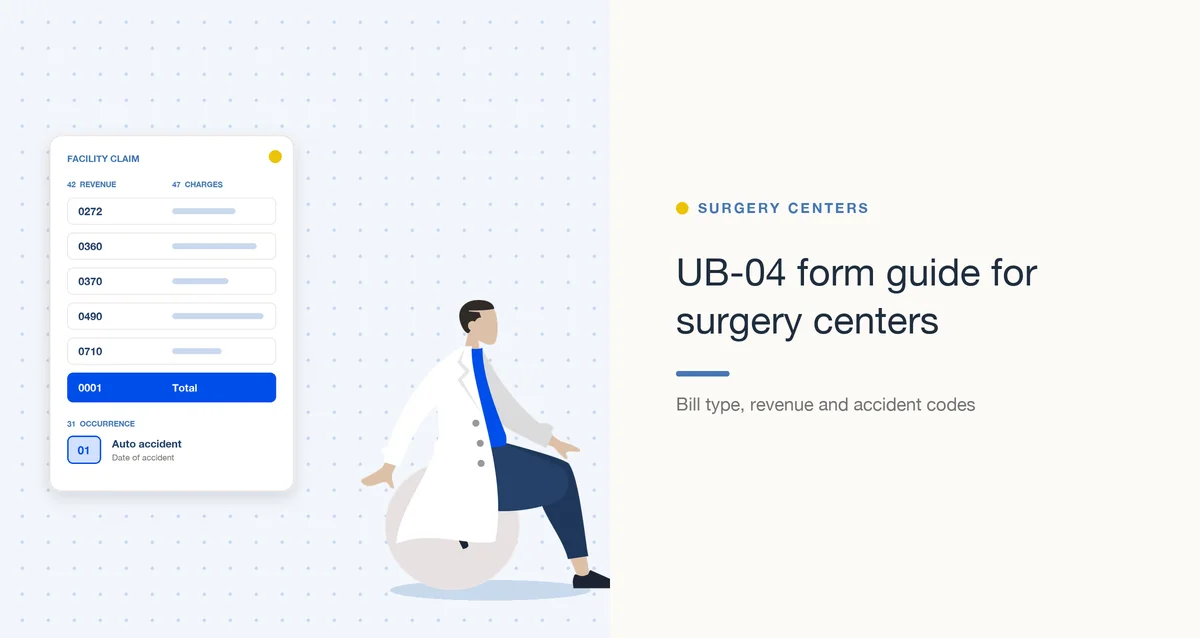
| 31 to 34 | Occurrence codes and dates | Event codes with dates, such as the date of an accident | The key personal injury fields; see below |
| 35, 36 | Occurrence span codes | Code with from and through dates | Required for inpatient claims; rarely used by an ASC |
| 38 | Responsible party | Name and address of the party responsible for the bill | Used when a payer of higher priority than Medicare is involved |
| 39 to 41 | Value codes and amounts | Codes for money amounts, in ascending order | Identifies no-fault, workers' compensation or liability coverage; see below |
| 42 | Revenue code | 4-digit code for each charge, in ascending order, with 0001 as the total line | See the revenue code section below |
| 43 | Revenue description | Short description of each revenue code | |
| 44 | HCPCS, rates | The CPT or HCPCS code for outpatient services, with up to 4 two-character modifiers | Use the procedure code that matches the operative report |
| 45 | Service date | A date for every line on outpatient bills (CMS lists 083x among them) | One line per service date |
| 46 | Units | Number of times the procedure was performed, when a HCPCS code is reported | |
| 47, 48 | Total charges, non-covered charges | Charge per line, with the grand total on the 0001 line | Bill standard charges, the same for every payer and for lien cases |
| 50 to 55 | Payer, health plan ID, release and prior payments | Up to three payers on lines A to C, in order of who pays first; FL 52 is the release of information indicator | When auto or liability coverage pays before Medicare, that payer goes on line A |
| 56 | Billing provider NPI | The facility's NPI | Required |
| 58 to 62, 65 | Insured's name, relationship, ID, group name and number, employer | One line per payer, matching FL 50 | |
| 63 | Treatment authorization code | Prior authorization or referral number from the payer | Common for elective orthopedic and spine procedures |
| 64 | Document control number | The payer's number for the original claim, used on corrections | |
| 66 | Diagnosis code qualifier | 0 for ICD-10 | |
| 67, 67A to 67Q | Principal and other diagnosis codes | The full ICD-10-CM code without the decimal, then other coexisting conditions | The principal diagnosis is the reason for the surgery |
| 69, 70 | Admitting diagnosis, patient's reason for visit | Admitting diagnosis is for inpatient claims; reason for visit is required only on certain hospital outpatient bills | Usually blank for an ASC |
| 72 | External cause of injury | Not used by Medicare | Some payers want the external cause code for an accident |
| 74 | Principal procedure (ICD-10-PCS) | Inpatient claims only; not used on outpatient claims | Leave blank |
| 76, 77 | Attending and operating provider | Name and NPI; FL 77 is required when a surgical procedure code is on the claim | The surgeon goes in FL 77 |
| 78, 79 | Other providers | Qualifier and NPI, such as DN (referring) or ZZ (other operating physician) | |
| 80 | Remarks | Information not shown elsewhere that is needed for payment | Medicare asks for annotations here when auto, no-fault or liability insurance is primary |
| 81 | Code-code field | Additional codes from NUBC-approved code lists, when the payer requires them |
Form locators 7, 30, 37, 49, 53, 57, 68, 71, 73 and 75 are unlabeled, reserved or not used by Medicare.
Which type of bill does a surgery center use in FL 4?
The UB-04 type of bill in FL 4 is a 4-digit code: a leading zero, then the facility type, the classification and the frequency. For facility type 8, CMS's data dictionary lists "Ambulatory Surgery Center (ASC) or other special facility", and it describes classification 3 under that type, the 083x bills, as an ASC in a hospital outpatient department.
Because freestanding centers bill Medicare in the professional format, the type of bill a freestanding ASC puts on a UB-04 comes from each payer's contract or manual. Confirm it before the first claim. The last digit, the frequency code, works the same everywhere:
| Frequency digit | Meaning (CMS) | When to use it |
|---|---|---|
| 1 | Admit through discharge claim | The normal, original bill for a surgery |
| 7 | Replacement of prior claim | Correcting a claim the payer already processed; put the original claim number in FL 64 |
| 8 | Void or cancel prior claim | Canceling a claim sent in error |
Which revenue codes does a surgery center use?
A surgery center's UB-04 groups its charges with 4-digit revenue codes in FL 42, listed in ascending order, with revenue code 0001 as the last line carrying the total. The codes below are the ones surgery centers use most; which ones a payer accepts, and whether it wants a single 0490 line or separate lines, depends on the contract.
| Revenue code | Meaning (CMS data dictionary) | Typical use |
|---|---|---|
| 0250 | Drugs and biologicals | Medications given during the case |
| 0272 | Medical/surgical supplies, sterile supply | Sterile supplies used in the procedure |
| 0278 | Medical/surgical supplies, other implants | Implants such as spinal hardware or orthopedic anchors, when the payer pays for them separately |
| 0360 | Operating room services, general classification | The operating room charge |
| 0361 | Operating room services, minor surgery | Minor procedures, where the payer splits OR charges |
| 0370 | Anesthesia, general classification | The facility's anesthesia charge (the anesthesia provider bills separately) |
| 0490 | Ambulatory surgical care, general classification | The surgery center facility charge, which some payers want as a single line |
| 0710 | Recovery room, general classification | Post-anesthesia recovery |
| 0001 | Total charges | The last line, with the sum of all charges in FL 47 |
Each line with a revenue code that needs a procedure code carries the CPT or HCPCS code in FL 44, a service date in FL 45 and units in FL 46. For a procedure stopped for a medical reason, Medicare's ASC rules use modifier 73 (stopped after the patient was prepared and taken to the room, before anesthesia) or 74 (stopped after anesthesia or the procedure started), with the operative report kept on file.