A CMS-1500 claim gets rejected for small things: a date in the wrong format, a decimal point in a diagnosis code, a missing state next to "auto accident". For a practice that bills both insurance and personal injury cases, the same form also becomes the bill an auto insurer or a patient's attorney reads at settlement, so the small things matter twice.
This CMS-1500 guide is for billers, office managers and practice owners at chiropractic, physical therapy, pain management, orthopedic and other outpatient practices. It walks through every item on the form, shows where Medicare's rules differ from the general NUCC instructions most other payers follow, and covers the fields that matter most on a personal injury claim.
This is general billing information, not legal or payer-specific advice. Each payer can add its own requirements. When a payer's instructions differ from this guide, follow the payer.
What is the CMS-1500 form?
The CMS-1500 is the standard paper claim form for professional services: the visits, procedures and supplies billed by physicians, chiropractors, therapists and other individual providers. The current version is the 02/12 form. Its general instructions are maintained by the National Uniform Claim Committee (NUCC), whose instruction manual version 13.0 was released in July 2025.
Most claims today travel electronically as the ASC X12 837 Professional transaction (837P), which carries the same data as the paper CMS-1500. The item numbers below still matter: billing software, clearinghouse error messages and payer manuals all refer to them.
Who uses the CMS-1500, and who uses the UB-04?
The CMS-1500 is used by professional providers: physician practices, chiropractic and physical therapy clinics, pain management and orthopedic practices, and other outpatient offices. The UB-04 (Form CMS-1450) is the institutional claim form used by hospitals and other facilities.
Surgery centers are the common exception. Medicare tells freestanding ambulatory surgery centers (ASCs) to bill on the 837 professional format, or in rare cases on the paper CMS-1500, not the UB-04. Some commercial, Medicaid and auto payers ask ASCs for a UB-04 instead, depending on the contract. Our UB-04 guide for surgery centers covers that form field by field.
How is the CMS-1500 laid out?
The CMS-1500 has 33 numbered items in two halves. Items 1 to 13 describe the patient, the insured person and any other coverage. Items 14 to 33 describe the condition, the services billed, and the provider who rendered and billed them. The top right corner holds the payer's name and address.
Two rules apply across the whole form, per CMS: dates of birth (items 3, 9b and 11a) use 8 digits, and all other date fields use either 6 or 8 digits. Pick one format for items 11b, 14, 16, 18, 19 and 24A and use it everywhere on the claim. Mixing them gets the claim returned.
CMS-1500 items 1 to 13: patient and insured information
Items 1 to 13 identify the patient, the insured person and the coverage being billed. On a personal injury claim, items 1, 10 and 11 carry the most weight, because they tell the payer an accident is involved and which plan pays first.
| Item | Field | What goes there | Personal injury note |
|---|---|---|---|
| 1 | Insurance type | One X for the type of coverage billed: Medicare, Medicaid, TRICARE, CHAMPVA, group health plan, FECA, Black Lung or Other. | NUCC defines "Other" as including commercial insurance, automobile accident, liability and workers' compensation. |
| 1a | Insured's ID number | The member ID from the insured's card. For Medicare, the Medicare beneficiary identifier, whether Medicare pays first or second. | For an auto claim, use the ID or claim number the auto insurer asks for. |
| 2 | Patient's name | Last name, first name, middle initial, exactly as on the card. | |
| 3 | Patient's birth date and sex | 8-digit date (MM DD CCYY) and sex. | |
| 4 | Insured's name | The policyholder. On a Medicare claim, fill it only when another plan pays before Medicare; enter SAME when the insured is the patient. | On a Medicare claim with auto or liability coverage primary, this item is completed. |
| 5 | Patient's address | Street, city, state, ZIP and phone. | |
| 6 | Patient relationship to insured | Self, spouse, child or other. | |
| 7 | Insured's address | The policyholder's address, or SAME. | |
| 8 | Reserved for NUCC use | Leave blank on the 02/12 form. | |
| 9, 9a, 9d | Other insured | On Medicare claims, used only for a Medigap policy the patient assigns to a participating provider. Other payers may use it for secondary coverage. | |
| 9b, 9c | Reserved | Leave blank on the 02/12 form for Medicare (9c only when 9d is not completed). | |
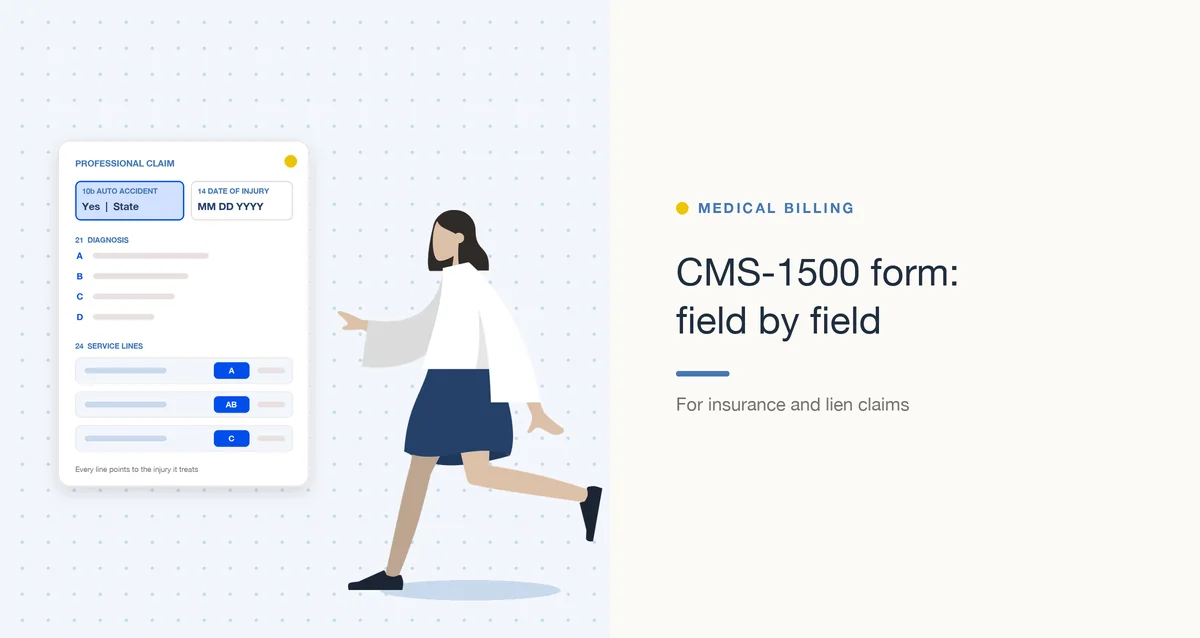
| 10a to 10c | Is the condition related to employment, auto accident or other accident? | YES or NO on each line. If 10b (auto accident) is YES, enter the 2-letter state where the accident happened. | The key personal injury field. A YES tells the payer another policy may be primary, and that policy then goes in item 11. |
| 10d | Claim codes | NUCC: condition or claim codes when a payer requires them. Medicare: the patient's Medicaid number preceded by MCD. | |
| 11 | Insured's policy or group number | NUCC: the policy or group number for the health, auto or other plan, with no hyphens or spaces. Medicare: required; enter the primary plan's number, or NONE if nothing pays before Medicare. | On a Medicare claim for an accident, a NONE here conflicts with a YES in item 10, and the claim gets questioned. |
| 11a to 11c | Insured's birth date, other ID, plan name | Birth date and sex if different from item 3; for Medicare, 11c holds the primary payer's ID or plan name when another plan pays first. | |
| 11d | Is there another health benefit plan? | YES or NO. Medicare leaves it blank. | |
| 12 | Patient's signature (release of information) | The patient's signature and date, or "Signature on File" when a signed authorization is kept in the chart. | This releases information to process the claim. It is not a HIPAA authorization to send records to an attorney. |
| 13 | Insured's signature (payment to provider) | Authorizes the payer to pay the provider directly. "Signature on File" works when signed separately. |
CMS-1500 items 14 to 33: provider and service information
Items 14 to 33 describe the injury date, the diagnoses, each service line and the provider. Item 21 (diagnoses) and item 24 (service lines) are where most claim errors happen, so check those two first.
| Item | Field | What goes there | Personal injury note |
|---|---|---|---|
| 14 | Date of current illness, injury or pregnancy | NUCC: the date plus qualifier 431 (onset of current symptoms or illness) or 484 (last menstrual period). Medicare: the date only, no qualifier. For chiropractic, Medicare wants the date the course of treatment started. | For an accident, this is the date of injury. It should match the date in the intake and every note. |
| 15 | Other date | NUCC: another date with a qualifier, such as 439 (accident), 454 (initial treatment), 444 (first visit) or 455 (last x-ray). Medicare: leave blank. | Some auto and liability payers want the accident date here with qualifier 439. |
| 16 | Dates patient unable to work | From and to dates when the patient could not work in their current job. | Useful in injury cases with lost wages; it must be supported in the notes. |
| 17, 17b | Referring, ordering or supervising provider | Name with qualifier DN (referring), DK (ordering) or DQ (supervising), and the NPI in 17b. Item 17a is left blank for Medicare. | Medicare requires the certifying physician of a therapy plan of care in 17 and 17b on physical, occupational and speech therapy claims. |
| 18 | Hospitalization dates | Dates of a related hospital stay, when services follow one. | Relevant after an ER admission tied to the accident. |
| 19 | Additional claim information | Payer-specific notes: a narrative for unlisted or NOC codes, the x-ray date for Medicare chiropractic claims, and other items the payer names. | |
| 20 | Outside lab | Used for diagnostic tests subject to Medicare's anti-markup rule. | |
| 21 | Diagnosis codes | ICD indicator 0 for ICD-10-CM, then up to 12 codes on lines A to L, in priority order, with no decimal points and no narrative. | List the injury codes the notes support. The external cause of the accident belongs in the chart, but check whether the payer wants it on the claim. |
| 22 | Resubmission code and original reference number | For a corrected claim: frequency code 7 (replacement) or 8 (void) plus the payer's original claim number. Never used on an original claim. Medicare leaves it blank. | |
| 23 | Prior authorization number | The authorization or referral number when the payer issued one. Medicare also uses it for items such as a CLIA number. | |
| 24A | Dates of service | From and to dates for each line. A span needs the number of days or units in 24G. | |
| 24B | Place of service | The 2-digit place of service code, such as 11 (office) or 24 (ambulatory surgical center). | |
| 24C | EMG (emergency) | Not required by Medicare; some payers ask for it. | |
| 24D | Procedures and modifiers | The CPT or HCPCS code and up to 4 modifiers. Unlisted codes need a description in item 19 or an attachment. | |
| 24E | Diagnosis pointer | The letter (A to L) from item 21 that explains the service, primary letter first. NUCC allows up to 4 letters with no commas; Medicare processes one per line. Never enter the ICD code itself here. | Point each treatment to the injury it treats. Attorneys and adjusters read this link. |
| 24F | Charges | The charge for the line. | Bill your standard fee. A lien bill should show the same charges as any other bill for the same service. |
| 24G | Days or units | Number of units; enter 1 for a single service. Anesthesia is reported in minutes. | Timed therapy codes must match the minutes in the note. |
| 24H | EPSDT or family plan | Medicaid-specific; left blank for Medicare. | |
| 24I, 24J | Rendering provider ID | The rendering provider's NPI in the unshaded part of 24J. A non-NPI ID goes in the shaded part with a qualifier in 24I. NUCC: fill only when different from items 33a and 33b. | |
| 25 | Federal tax ID | The EIN or SSN, with the matching box checked. | |
| 26 | Patient's account number | Your internal account number; it is returned on payment notices. | Use the account or case number your team searches by. |
| 27 | Accept assignment? | YES or NO. NUCC asks that it be reported for all payers. | |
| 28 | Total charge | The sum of all charges in 24F. | |
| 29 | Amount paid | What the patient (or, for some payers, another payer) has already paid toward these services. | Record any partial payments so the balance on the bill is right at settlement. |
| 30 | Reserved for NUCC use | Leave blank. | |
| 31 | Provider signature and date | The provider's or representative's signature and date; "Signature on File" or a computer-generated signature is accepted. | |
| 32, 32a | Service facility location | Name, address and ZIP of where the service was given, and its NPI in 32a when required. Medicare requires the location for all places of service. Item 32b is not reported for Medicare. | |
| 33, 33a | Billing provider | The billing name, address, ZIP and phone, and the billing NPI in 33a. Both are required. |
How do you fill out a CMS-1500 for a car accident patient?
A CMS-1500 for a car accident patient needs three things a routine claim does not: YES in item 10b with the 2-letter state where the accident happened, the date of injury in item 14, and the policy that pays first in item 11. Some auto and liability payers also want the accident date in item 15 with qualifier 439.
Which box you mark in item 1 depends on who you are billing. Bill the health plan, and you mark that plan. Bill the auto insurer directly, and NUCC classifies automobile accident and liability coverage as "Other". On a Medicare claim, a YES in item 10 signals that auto or liability coverage may be primary, so item 11 must name that coverage, or say NONE only if none exists.
- Match the dates. The date of injury in item 14 should match the intake, the first note and the attorney's records.
- Point every line to the injury. Each service in 24E should point to the diagnosis it treats in item 21.
- Use the same charges. Bill your standard fees, whether the bill goes to a health plan, an auto insurer or an attorney.