Uber's RICO Lawsuits Against Personal Injury Doctors: What Clinics Should Learn
Uber has sued personal injury law firms, doctors, clinics and a surgery center under federal racketeering law in 4 states. What the suits allege, where each case stands, and what practices should document now.
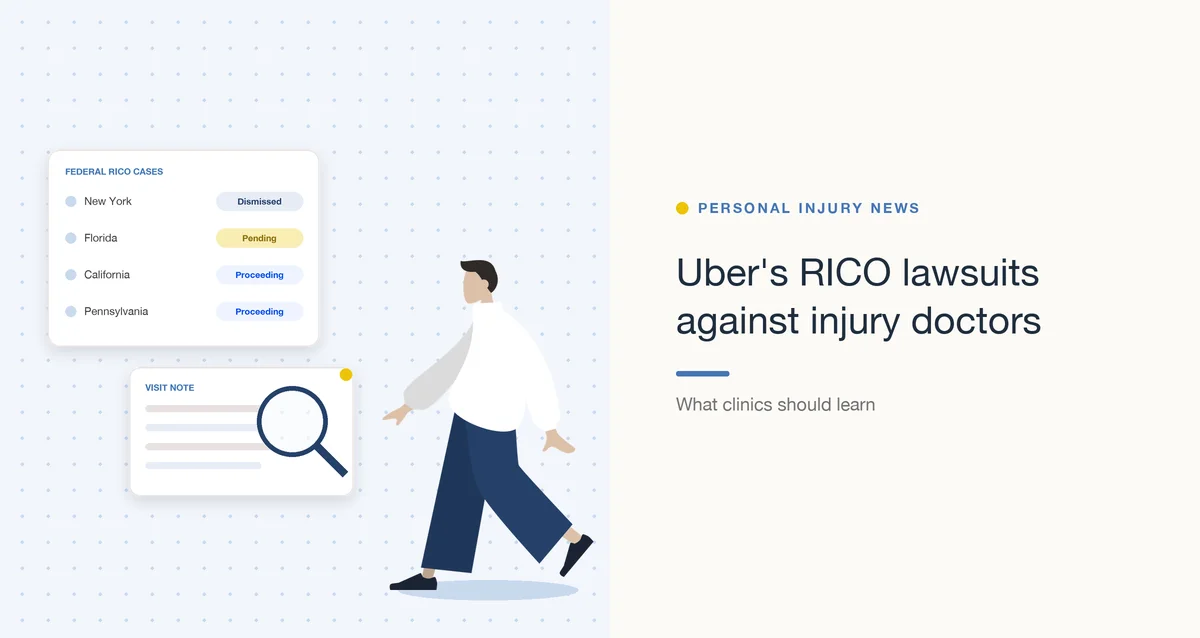
Updated December 3, 2026. Since January 2025, Uber has filed federal racketeering (civil RICO) lawsuits against personal injury law firms, the doctors and clinics their clients were treated by, and in one case a surgery center. The suits allege that attorneys steered injured passengers to preselected providers, and that those providers produced records and bills that inflated the claims. The cases are in New York, Florida, Pennsylvania and California, and the results so far are mixed.
These are allegations, not findings. No court has decided that any defendant committed fraud, and the defendants deny the claims. This post explains what the suits allege, where each one stands, and what any practice that treats personal injury patients can learn about documentation, referrals, billing and records.
General information, not legal advice. Case status is based on court filings and published reports as of November 2026 and can change. Talk to a licensed attorney about your own practice.
What are Uber's RICO lawsuits about?
Uber's RICO lawsuits claim that groups of personal injury attorneys and medical providers worked together to exaggerate injuries from car accidents involving Uber drivers. According to the complaints, attorneys referred clients to a set network of providers, the providers documented serious injuries and recommended treatment or surgery, and the resulting records and bills were used to demand larger settlements from Uber and its insurers.
The federal Racketeer Influenced and Corrupt Organizations Act (RICO) lets a company sue for triple damages if it proves an "enterprise" engaged in a pattern of fraud that injured its business. That is a high bar: the plaintiff has to show a shared fraudulent purpose and a concrete loss, not just a business relationship.
Where does each case stand?
Case
Court and filing date
Who is named
Status (as reported, November 2026)
Uber Technologies v. Wingate (New York)
U.S. District Court, Eastern District of New York; filed January 30, 2025
3 personal injury law firms and attorneys, doctors and pain management clinics
Dismissed in August 2026. Uber said it is considering its options.
Uber v. Law Group of South Florida (Florida)
U.S. District Court, Southern District of Florida; filed June 2025
A law firm, medical and diagnostic providers, and drivers in allegedly staged crashes
Pending; no ruling on the merits reported.
Uber v. Downtown LA Law Group (California)
U.S. District Court, Central District of California; filed July 21, 2025
2 law firms, a spine practice, a surgeon and a surgery center
Moving forward. In August 2026 the judge let most RICO claims proceed and dismissed one conspiracy count.
Uber Technologies v. Simon & Simon (Pennsylvania, with FedEx)
U.S. District Court, Eastern District of Pennsylvania; filed 2025
A Philadelphia law firm and treating providers, including chiropractors and pain specialists
Moving forward. In May 2026 the judge denied the motion to dismiss.
Surviving a motion to dismiss means only that the allegations, if true, could support a claim. It is not a finding that anything alleged happened.
Why did the New York judge dismiss Uber's case?
The New York federal judge dismissed Uber's RICO case because Uber did not plausibly show that the law firms and doctors shared a common purpose to defraud it, or that it had suffered a provable injury yet. According to the published ruling summary, the facts at most showed benefits "incidental to an ordinary and lawful client-referral relationship and third-party litigation financing of medical treatment."
The judge also wrote that "nothing suggests anything more than routine medical referrals and medical declarations." Because 3 of the 5 underlying cases were still pending, Uber's damages were not yet provable. The court declined to rule on Uber's state-law claims.
Why did the Pennsylvania and California cases move forward?
The Pennsylvania and California judges found the complaints detailed enough to continue. In Pennsylvania, Uber and FedEx alleged a "conveyor belt of preselected treatment providers and medical experts," and the judge held that the defendants' right to petition the courts did not end the case at this early stage. In California, the judge rejected the law firms' argument that the same doctrine shields litigation alleged to be a sham.
The practical difference between the cases is detail. Where the complaints described specific patients, records and bills, the cases survived. Where they described loose groups and conclusions, the New York case did not.
What should practices that treat personal injury patients learn?
The lesson for personal injury practices is that their records, bills and referral history can end up as evidence in someone else's lawsuit. Treating attorney-referred patients on a lien is lawful and common. What matters is that each patient's chart can show, on its own, why each service was provided and billed.
What the suits target
What a practice can keep on every case
Treatment alleged to be unnecessary
Findings at each visit and the reason for each next step, written at the time, not reconstructed later.
Injuries alleged to be exaggerated
Notes that differ visit by visit as the patient changes. Repeated, copied text is easy to attack.
Causation statements alleged to be false
Opinions tied to documented history, exam findings and imaging in the chart.
Attorney steering to preselected providers
The referral source recorded on each case, and referrals you can explain as patient care.
Inflated bills
Itemized, coded bills that match the visits and procedures in the chart.
Records used to push settlements
A log of which records went to which firm, and when.
What should a practice do now?
Review a sample of personal injury charts. Check that each note stands on its own and that treatment decisions are explained.
Record the referral source on every case, including the attorney or firm, so you can answer questions from records rather than memory.
Match bills to the chart. Every billed service should have a note and a code behind it.
Know who holds your receivables. If you sell or finance liens, keep the agreements on file. The New York ruling and California's SB 623 both put litigation financing in view.
Keep a record of what you send to law firms. Send only what the patient authorized, and log it.
Ask your attorney to review your lien forms, referral relationships and records-request process.
Practices that use Ambula's personal injury EMR keep the referring attorney on each case, build case reports and itemized bills from the chart, and share records through the Lawyer Portal, which keeps a history of what each firm was sent and opened.
Frequently asked questions
Has any court found that the doctors in Uber's lawsuits committed fraud?
No court has found fraud by any defendant in Uber's RICO lawsuits as of November 2026. The New York case was dismissed, and the Florida, California and Pennsylvania cases are still at early stages where the court assumes the allegations are true only to decide whether the case can continue. The defendants deny the claims.
Is it legal for a practice to treat patients referred by a personal injury attorney?
Treating patients referred by a personal injury attorney is a common and lawful practice, and the New York judge described the referrals in that case as "routine." Problems arise when a referral involves payments, ownership ties or agreements about treatment or billing. State rules differ, so ask a licensed attorney about your own arrangements.
What is a civil RICO claim?
A civil RICO claim is a federal lawsuit alleging that a group acted as an enterprise through a pattern of crimes such as mail or wire fraud, injuring the plaintiff's business or property. A winning plaintiff can recover 3 times its damages. Courts require detailed allegations of fraud and a concrete, provable loss.
Why are Uber's lawsuits relevant to practices outside these 4 states?
Uber's lawsuits show how a defendant can use a practice's own records, bills and referral history against it, and that approach is not limited to one state. Laws such as California's SB 623 also make referral and financing relationships discoverable in some cases. Clear, consistent records protect a practice wherever it treats personal injury patients.
What records would matter most if a practice were drawn into a case like this?
The records that matter most are visit notes that explain each treatment decision, itemized bills that match those notes, the referral source for each case, any lien or financing agreements, and a log of what was sent to each law firm. Keeping these complete from the start is easier than rebuilding them later.
This content is for informational purposes only. It summarizes allegations in court filings and published reports of court rulings; it does not state that any person or business engaged in wrongdoing. Consult a licensed attorney for advice about your practice.
Mousa leads product management and content at Ambula. He joined Ambula four years ago as its SEO specialist and now works on how the EMR handles the personal injury case, from intake to settlement. He writes about running a personal injury practice and healthcare digitalization.